

Beans and pulses offer multiple benefits for nutrition, net zero, and nature, but current UK consumption is low and much of what is eaten is imported. Scaling up pulses requires coordinated change across production, processing, policy, and consumer habits. In this blog, Dr Jing Zhang, a researcher with the Food Systems Transformation Group at the Environmental Change Institute, reflects on recent research that maps a practical roadmap for increasing UK pulse production and consumption, and outlines the steps needed to turn potential into action.
Beans and pulses are often presented as a simple solution — supporting soil health, enabling lower-carbon diets, and improving human nutrition.
In practice, however, realising these benefits in the UK is far from straightforward. Current consumption remains low, with people in the UK eating less than 10 grams of beans and pulses per day on average. Where pulses are consumed, they are often in a limited range of products, and a large share is imported rather than grown domestically. This raises a key question: how can the multiple benefits of pulses on nature, net zero and nutrition be realised in the UK in practice?

Building on the momentum of the BeanMeals project — led by Dr John Ingram at the Environmental Change Institute — a new Agile Science to Policy project, Roadmap for UK Beans, led by myself has taken the next step. The focus has shifted from understanding the role of pulses in the UK food system to asking what a 2035 vision could look like, and what needs to happen — across practice, policy and research — starting now to make that vision a reality.
BeanMeals, part of the Transforming UK Food Systems programme, highlighted the potential of pulses to support healthier diets, lower environmental impacts, and local economic activity. At the same time, it showed that achieving these outcomes requires systemic innovation — and that progress remains fragmented across production, processing, markets and policy. This project builds on that foundation, moving beyond what could change to how change can be delivered.
From insights to a roadmap
The project set out to develop a UK pulses roadmap: a shared direction for how beans and pulses could contribute to nature recovery, net zero and improved nutrition.
This work combined rapid evidence synthesis, targeted stakeholder conversations, and two workshops bringing together actors across the food system.
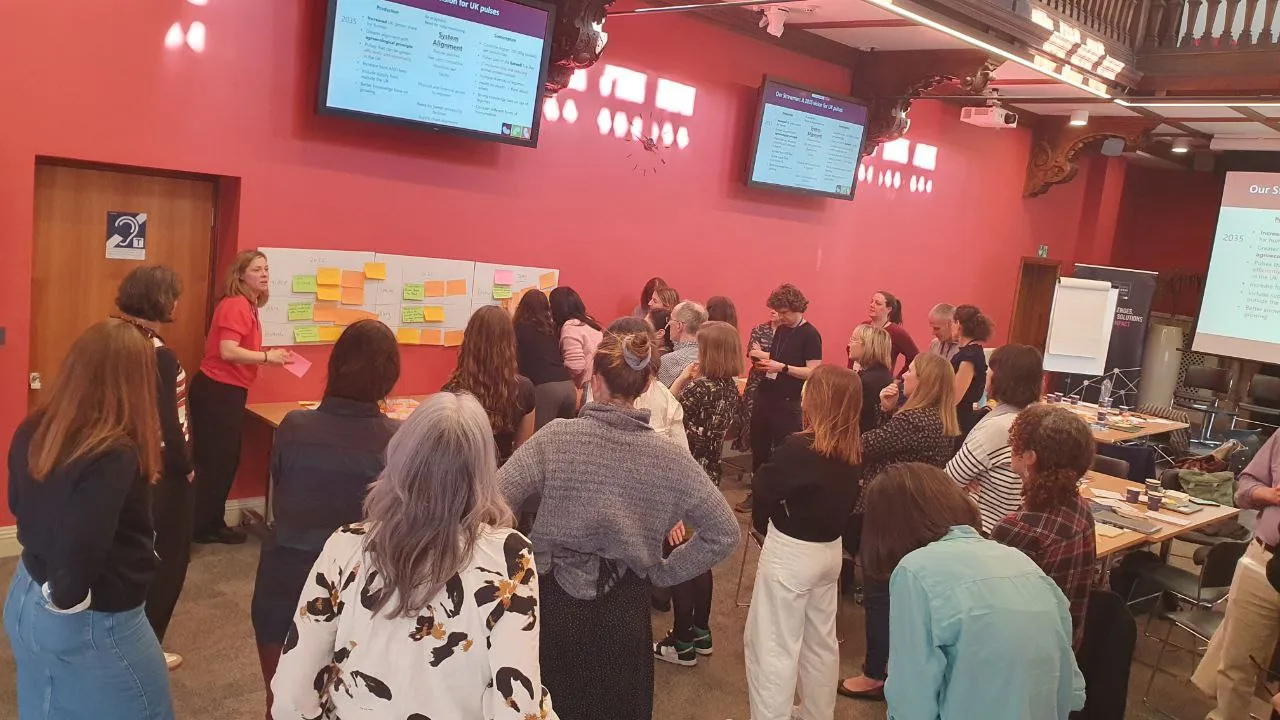
The first workshop involved over 30 stakeholders from around 20 food system organisations, spanning agriculture, food businesses, civil society and policy. Participants worked together to define a shared 2035 direction — including ambitions for increased consumption aligned with dietary guidance and greater UK production — and to map backwards the actions required across practices, policy and research.
A key insight was that scaling pulses is not a single intervention. It requires coordinated change across the system — including investment in processing, shifts in dietary habits, and policy frameworks that make pulses a viable option for farmers and businesses.
This work was a collaborative effort between the Food Systems Transformation Group at the Environmental Change Institute and the Agricultural Resilience Impact and Innovation Hub (AGRIIH), with facilitation support from Forum for the Future.
From roadmap to research agenda
A second workshop, held with researchers at the final Transforming UK Food Systems conference, focused on responding to the stakeholder co-created roadmap and aligning a research agenda with it.
Rather than revisiting actions, participants identified key research gaps and questions that need to be addressed to enable this transition. Across themes of land use, food-system coordination and diets, discussions highlighted that many barriers are not only practical, but also linked to gaps in knowledge — particularly around policy design, system interactions, trade-offs, and viable pathways for scaling pulses.

What comes next
Releasing the potential of pulses will require stronger coordination across sectors, clearer policy signals, and a more robust evidence base. The roadmap and emerging research agenda aim to support this by providing a shared direction and identifying where collective effort is needed.
We are now working to synthesise these insights and feed them into ongoing discussions with policymakers. The project is already in dialogue with DEFRA and relevant agencies across the UK nations, with the aim of ensuring that pulses are more clearly embedded in future food, farming and climate strategies.
This research was supported by the Agile Initiative at the Oxford Martin School and the Natural Environment Research Council as part of the Changing the Environment Programme (NERC grant reference number NE/W004976/1).