
The University of Oxford has signed three landmark agreements with leading Vietnamese partners, deepening collaboration across healthcare, higher education, and sustainable aviation.
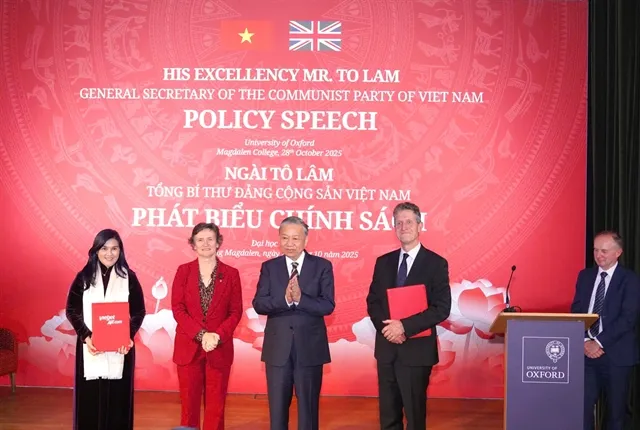
L-R: Ho Ngoc Yen Phuong, Vietjet Deputy General Director; Professor Irene Tracey, Vice-Chancellor of the University of Oxford; To Lam, General Secretary of the Communist Party of Vietnam (CPV) Central Committee; Professor Myles Allen, Climate Programme Lead, ECI and Director of Oxford Net Zero.
During a visit to the University, To Lam, General Secretary of the Communist Party of Vietnam (CPV) Central Committee, signed several cooperative agreements supporting academic collaboration with two University research centres, and formally launched a new scholarship scheme for Vietnamese students.
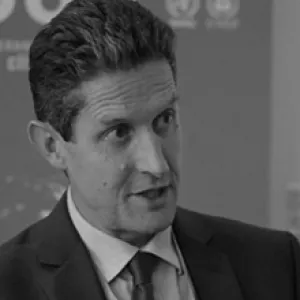
One of the partnerships is between VietJet and Oxford Net Zero, led by Professor Myles Allen, the Climate Programme Lead at the Environmental Change Institute. The Net Zero Aviation Project is a £1.6 million research collaboration running until mid-2026.
The project, conducted with the International Air Transport Association (IATA), investigates geologically balanced fuels (GBFs) — a novel approach to offsetting aviation emissions by capturing and permanently storing equivalent CO₂ in geological formations. Emissions from aviation are projected to increase steadily in the coming years, and they are currently some of the hardest emissions to abate. The aim of the Net Zero Aviation Project is to look at a potential new way of tackling this challenge by looking at the feasibility, public perception, and impact of GBFs, alongside equity and justice implications. It ultimately aims to develop policies and reporting standards which support gradually increasing the fraction of emissions captured and stored over time through cooperation between the aviation sector and their fuel suppliers.
Professor Allen said:
The Oxford Net Zero initiative is delighted to be working with VietJet and the International Air Transport Association, IATA, on strategies for neutralising the climate impact of aviation. We are specifically exploring the concept of ‘geologically balanced fuels’ as potentially an affordable, scalable, and responsible complement to sustainable aviation fuel. Working with a low-cost carrier with a commitment to both sustainability and affordability, based in South East Asia — one of the world’s fastest-growing aviation markets — brings together in microcosm all the challenges faced by the global aviation sector.”
Read more in the announcement from the University of Oxford.