

A new study led by the ECI has found that the speed at which tropical cyclones move — not just how strong they are — plays a crucial role in determining how mangrove ecosystems are damaged during storms.
The research, published in Science Advances, is the first global analysis to quantify how cyclone travel speed shapes different mechanisms of mangrove damage and how these risks are shifting under climate change.
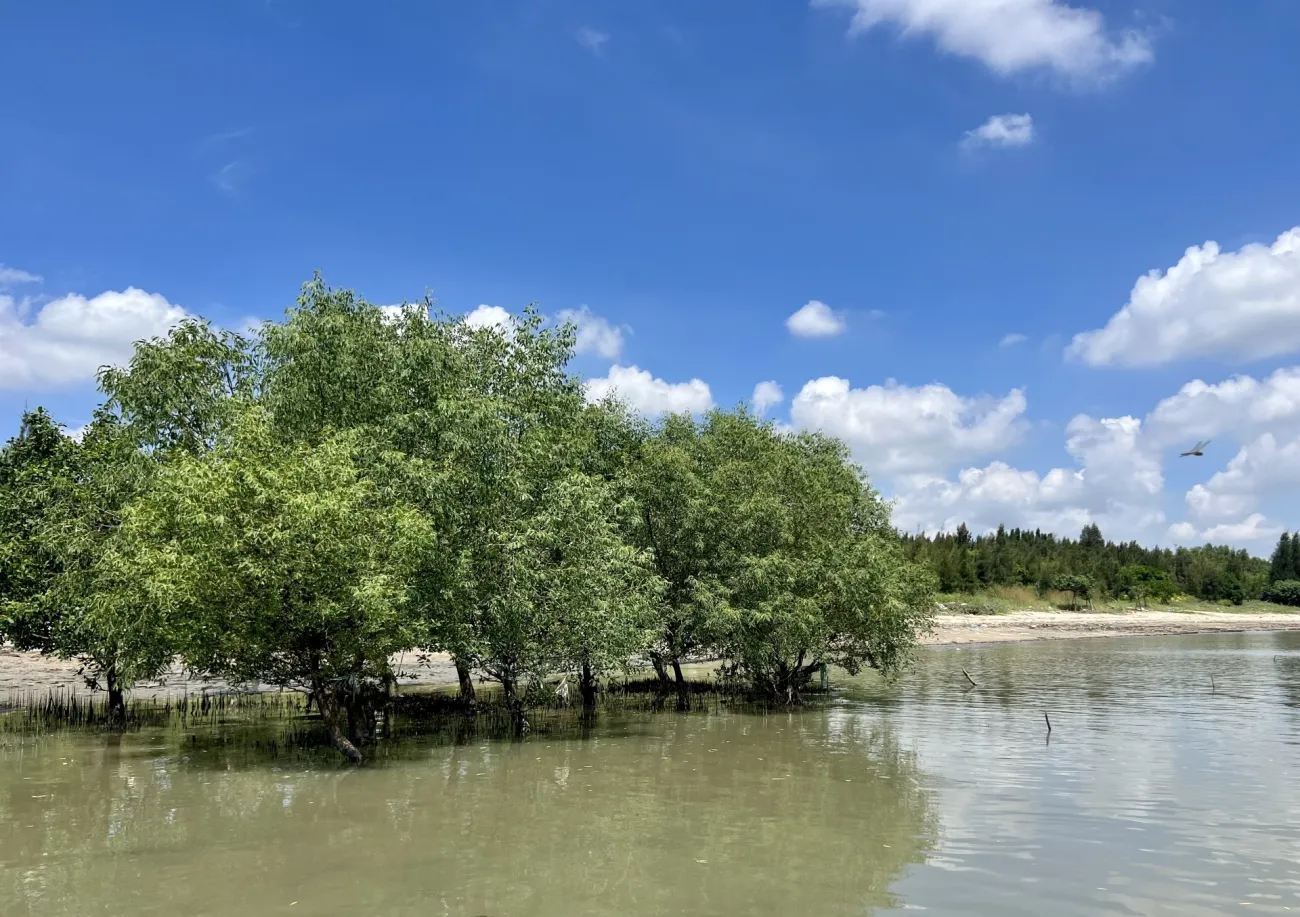
East Shore Mangrove Restoration Area in Shantou, China
The paper, “Shifting cyclone travel speed and its impact on global mangrove ecosystems,” is led by Dr Yu Mo, Research Fellow at the Environmental Change Institute (University of Oxford) and Trinity College Dublin, with co-authors from the United States and Ireland. The team also includes Professor Jim Hall, Professor of Climate and Environmental Risk and Lead of the ECI’s Oxford Programme for Sustainable Infrastructure Systems (OPSIS).
Fast-moving and slow-moving cyclones damage mangroves in fundamentally different ways
Using more than 20 years of global satellite data and all recorded cyclones between 2001 and 2021, the researchers developed an interpretable machine-learning model that explains 68% of global variation in cyclone damage — an exceptionally high level for environmental systems.
The study identifies two distinct damage pathways:
- Fast-moving cyclones (≥25 km/h) produce intense physical destruction, including tree snapping, canopy loss, erosion and shoreline retreat.
Damage is especially severe where coastlines are steep, allowing waves and surge energy to concentrate directly onto mangrove areas. - Slow-moving cyclones (<25 km/h) cause hydrological and biogeochemical damage, including prolonged flooding, sediment smothering and salinity or oxygen stress.
These impacts are greatest on gently sloping coasts, where stormwater pools and drains slowly.
Dr Mo said:
Cyclones don’t just vary in intensity — they behave differently in ways that produce completely different types of damage. Understanding these mechanisms gives us a crucial new lens for managing vulnerable coastlines.
“This study shows that changes in cyclone travel speed can alter not only how much damage occurs, but what kind of damage ecosystems experience. These insights are vital for designing effective and climate-resilient coastal management strategies.”
Global exposure to cyclones has increased 13% — but regional risks are shifting dramatically
Analysing four decades of cyclone activity (1981–2020), the researchers reveal a 13% increase in global cyclone exposure for mangrove ecosystems, driven partly by long-term changes in cyclone movement.
However, the most striking results appear at the regional scale:
- East Asia now faces by far the highest exposure to strong cyclones, with fast-moving strong cyclone exposure doubling over 40 years.
- The Caribbean has experienced a doubling of exposure to slow-moving strong cyclones, elevating the risk of prolonged flooding and dieback.
- Australasia and Southeast Asia have seen declines in exposure to all cyclone types.
- Cyclone intensity and rainfall have also shifted, with notable increases in the North Atlantic, East Asia and Southeast Asia.
These regional differences reflect broader atmospheric and oceanic trends, including observed poleward migration of some cyclones and increases in rainfall.
A new tool for forecasting risk — and for planning coastal resilience
Because mangroves provide essential services — from storm protection and carbon storage to fisheries support and shoreline stability — understanding cyclone impacts is critical for climate adaptation.
The study offers recommendations for policymakers and coastal managers to consider in efforts to reduce damage and enhance recovery:
- Where fast-moving cyclones dominate:
Protect steep coastlines from erosion, avoid engineering projects that steepen slopes, and promote nature-based solutions like oyster reefs to reduce wave energy. - Where slow-moving cyclones are increasing:
Prioritise drainage restoration, maintain freshwater inflows and natural tidal exchange, and protect hydrological pathways.
The team’s modelling approach — combining global remote-sensing data with interpretable machine learning — provides a powerful new framework for anticipating how changing cyclone behaviour will affect mangroves in the future.
As tropical cyclones intensify and shift their behaviour under climate change, the stakes for mangrove ecosystems and the coastal communities they protect continue to grow.
Read the full paper in Science Advances: Shifting cyclone travel speed and its impact on global mangrove ecosystems