


A new study from Oxford’s Environmental Change Institute (ECI) explores whether the tools used to study the global food system really show how it responds to shocks — and how improving them could help make food supplies more resilient.
Published in One Earth, the paper, “Getting into the doughnut: A framework for assessing systemic resilience in the global food system”, introduces a new framework to assess whether quantitative models, which scientists use to explore possible food systems behaviour, capture the key system features relevant for their resilience. Resilience here means the ability to buffer, adapt, or transform to mitigate the impacts of crises such as extreme weather, soil fertility collapse, supply chain breakdowns, pandemics, trade restrictions, or geopolitical conflict.
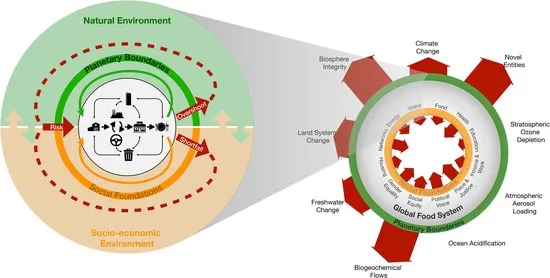
Lead author Estelle Paulus, a DPhil student at the ECI, and co-author Professor Michael Obersteiner, ECI Director, highlight that because the global food system is so complex and constantly changing, past experience is not sufficient to predict or prepare for future risks. Instead, models are often used as a tool to capture possible system behaviour under different conditions and to aid decision makers aiming to enhance resilience. However, this requires understanding which properties of the system are relevant for resilience and whether the models are able to represent them sufficiently. For example, the interconnected structure of the food system, through which problems in one sector or location, like a failed harvest in one country or the closure of a shipping bottleneck, may lead to cascading consequences, such as increasing food prices or food availability in different countries. Such cascading effects are often unexpected and might be much more drastic than the initial shock.
Estelle said:
In complex systems like our global food system, you can’t simply predict future risks based on the past. Our framework helps reveal whether the models we use can capture that complexity — and where they fall short — so that we can design better tools to prepare for the challenges ahead.”
The study applies the new framework to five commonly used modelling approaches and finds that to date, all of them are experiencing some difficulties in capturing resilience. This means that, when blindly relying on these models’ predictions, policymakers could misjudge the possible behaviour of the system, missing current vulnerabilities and opportunities to strengthen resilience – hence risking unexpected and undesirable side-effects of policies aiming to build resilience. By identifying these limitations and their consequences, the research offers practical guidance for improving models and informing better policy decisions.
This work is part of ECI’s broader effort to understand systemic risks and resilience in environmental and economic systems — helping societies prepare for an uncertain future and build more sustainable, adaptive food systems worldwide.
Read the full study in One Earth: Getting into the doughnut: A framework for assessing systemic resilience in the global food system
Learn more in Estelle Paulus’ blog, where she reflects on the ideas behind the study.