

In this blog, ECI DPhil student Estelle Paulus reflects on her recent paper, “Getting into the doughnut: A framework for assessing systemic resilience in the global food system”, published in One Earth (Cell Press). She shares the thinking behind the study, what inspired the new framework, and why understanding systemic resilience is essential for building a stronger, fairer global food system.
Getting Into the Doughnut: A New Way to Think About the Global Food System
The world’s food system, including everything from agricultural production to food waste, has been experiencing many shocks in recent years, with a growing tendency for disruption in the future. Crises, such as the COVID-19 pandemic or Russia’s war against Ukraine, have shown how quickly disruptions can ripple through international supply chains, affecting farms, factories, markets and kitchens, leaving millions hungry and economies rattled. In our paper Getting Into the Doughnut: A Framework for Assessing Systemic Resilience in the Global Food System, we set out to answer a pressing question: How can we better understand, model and strengthen the food system to build resilience against systemic shocks and keep feeding everyone?
The Doughnut Lens
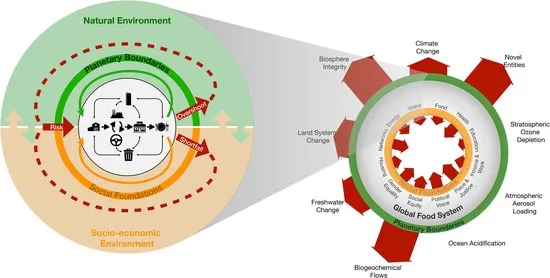
Inspired by Kate Raworth’s “Doughnut Economics,” we use the doughnut to explain the interlinked concepts of sustainability and resilience for the global food system. The inner ring represents the social foundations we need to meet (food security, nutrition, equity, etc.), including social and economic outcomes. The outer ring marks planetary boundaries (climate change, biodiversity loss, water use, etc.); we must not exceed to not overstretch Earth's carrying capacity. The safe and just space, the “dough”, is where a sustainable global food system needs to operate to not drive additional risks for the future, while resilience means keeping it inside the Doughnut despite shocks and disturbances.
Seven Key Criteria
Resilience isn’t just about bouncing back after a storm; it’s the ability of a system to buffer, adapt and transform to keep delivering its core outcomes, healthy and nutritious food, economic and social outcomes, such as livelihoods and a healthy planet, even when shocks hit. The global food system is a classic “complex system”: countless actors (farmers, traders, consumers, governments), working across inter-linked sectors (production, processing, transport, retail, consumption, waste) in a self-organised manner and experiencing feedback that can amplify small disturbances into major crises. To build resilience, we need to account for this complexity to steer it effectively and avoid unintended consequences. Hence, in our paper, we developed 7 criteria to guide a structured reflection on policies and modelling approaches to identify their potential for assessing or building resilience.
- Aim – Providing Food Sustainably
Is the sustainability of all outcome dimensions considered when aiming to build resilience? - Scope & Scale
Are all relevant sectors, dimensions (economic, social, environmental) and geographic scales considered? - Uncertainty
Risks are highly uncertain and can’t be predicted. Is this uncertainty considered, and approaches selected which do not overly focus on a specific risk? - Structure & Spatial Heterogeneity
Is the network of trade links, infrastructure and regional differences that shape risk transmission considered? - Actors & Behaviour
Are the diverse motivations, capacities and decision-making styles of individuals, corporations, institutions and policymakers reflected? - Emergent Dynamics
Are feedback loops, cascading failures and self-organising patterns that might lead to risk considered and visualised? - Non-Food Actors & Systems
Is the interconnection with other systems, such as energy, finance, health, and climate, considered such that spillover effects and feedback can be accounted for?
Putting the Criteria to Work
We tested five popular modelling approaches, equilibrium-based (e.g., CGE), input-output, network, agent-based and system dynamics models, against the criteria to reveal their strengths and limitations for being used for resilience assessment and policy work.
- Equilibrium models link economic sectors but assume markets instantly re balance, making it hard to capture cascading shocks or emerging risk.
- Input-output models map trade flows well but are static and lack detail on actor behaviour and feedback.
- Network models show who is connected to whom, yet often miss the richness of decision-making and policy levers.
- Agent-based models represent heterogeneous actors and adaptive behaviour, but they demand huge data and computing power.
- System dynamics models illustrate feedback and long-term trends, though they tend to aggregate away spatial detail.
Our results revealed significant gaps in the current available model for assessing systemic resilience, but more importantly, linked each limitation to the potential consequences we might be facing if they are ignored. Hence, our takeaway is that we need to be more aware of these limitations when using the results of existing models and blend strengths for more comprehensive assessments and models in the future, such as coupling an agent-based layer for actors with a network backbone for trade, all wrapped in a system dynamics engine that tracks feedback over decades.
Why This Matters for Everyone
A more realistic, transparent model helps policymakers test “what if” scenarios: What happens if a major grain exporter faces a drought? How would a sudden trade ban affect food prices in low-income countries? Which interventions (e.g., diversified sourcing, strategic reserves, redundancy) reduce systemic risk? By exposing hidden vulnerabilities, the framework guides smarter investments, clearer communication and more inclusive governance.
Looking Ahead
Our paper is a call to action for researchers, data providers, governments and the private sector. Building the next generation of food system models will require open data, interdisciplinary collaboration and a willingness to embrace uncertainty. We hope to thus contribute to building a more sustainable and resilient food system – a resilient Doughnut feeding everyone and fulfilling social and economic needs, while serving and protecting people and the planet.
__________________________________________________________________________________________________
Read the full study in One Earth: Getting into the doughnut: A framework for assessing systemic resilience in the global food system