

Scaling up heat pump deployment is a key challenge in the UK’s transition to net zero. In this blog, Dr Peter Mallaburn, Honorary Research Associate who works on Policy Analysis and Impact at the Environmental Change Institute, explores why the UK market has struggled to move beyond demonstration mode and how a new Warm Homes Agency could help support the transition to a mass market.

The decarbonisation of domestic heat is widely recognised as the "wicked problem" of the UK’s transition to net zero. Unlike electricity generation, where emissions can be slashed by intervening in a relatively small number of power plants and networks, fixing heat requires changing millions of individual lives.
These are not just technical assets; they are homes. They are privately owned, long-lived, and deeply embedded in our everyday routines and comfort. Unlike buying a new smartphone or even an electric vehicle, changing a heating system is an infrequent, high-stakes distress purchase. It involves ripping out the heart of a home’s infrastructure.
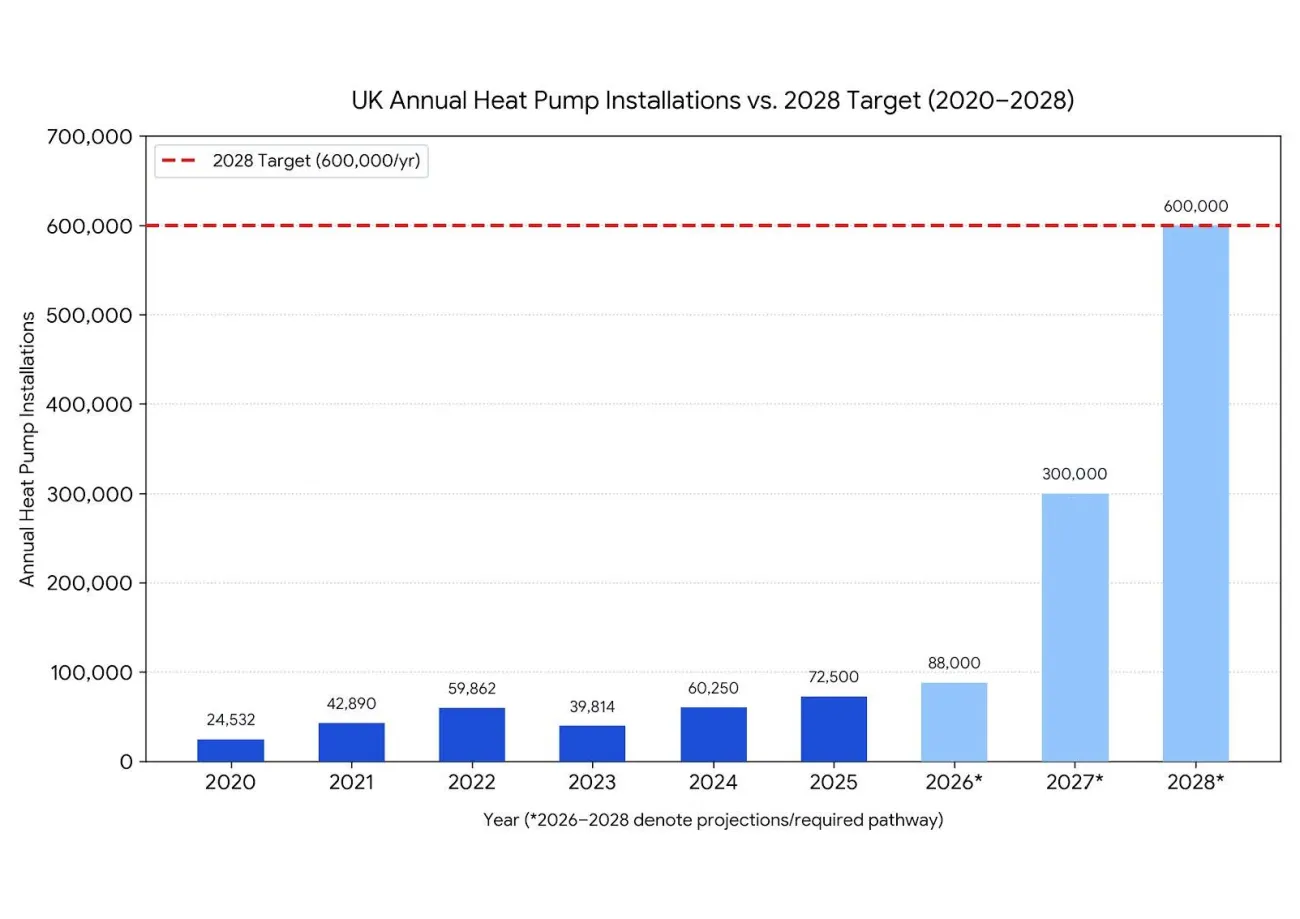
The scale of the challenge is immense, but the UK’s current trajectory is concerning. To meet the government’s ambition, the UK needs to reach 600,000 heat pump installations per year by 2028. Currently, the market is operating well below that scale. While annual installations have increased modestly over the last decade, they remain below 100,000 units per year.
This isn’t just a "slow start" - it is a fundamental misalignment. The growth rate required to hit the 2028 target is not incremental; it is exponential.
So, why are we stuck?
Common wisdom often blames our high energy prices (specifically the spark gap between electricity and gas), our drafty Victorian housing stock, or the readiness of the technology itself. But a new analysis suggests these are not the primary culprits. When we look at international comparators like Germany, the Netherlands, and Ireland - countries with similar building stocks, legacy gas networks, and democratic constraints - we see they are succeeding where we are stalling.
The real problem is structural. The UK is an outlier because it has not yet made the institutional shift from a "demonstration-style" delivery model to a routine, scalable mass market. We are trapped in a cycle of bespoke projects and fragmented delivery. To break out, we don't just need more subsidies; we need a new institutional architecture. We need a Warm Homes Agency.
───────────────────────────────────────────────────────
Part I: The diagnosis—the "demonstration mode" trap
To understand why the UK is failing to scale, we must first distinguish between two very different types of markets: "Demonstration Mode" and "Mass Market". This distinction is not merely descriptive; it reflects fundamentally different underlying system dynamics, actor incentives, and institutional requirements.
The characteristics of demonstration mode
The UK heat pump market currently exhibits almost all the defining features of a system stuck in demonstration mode. In this phase, the technology works technically, but it is institutionally marginal.
- Bespoke delivery: Every installation feels like a construction project rather than a product purchase. Installations are designed and delivered on a case-by-case basis, with high levels of customisation and uncertainty. There is little standardisation in design or deployment.
- High "soft costs": Because everything is bespoke, the costs associated with system design, consumer engagement, and project management remain stubbornly high. Installers spend significant time quoting for jobs they do not get, and this overhead is baked into the price for everyone else.
- Thin supply chains: Installer capacity is thin and geographically uneven. This lack of density reduces competition and restricts consumer choice.
- Complex consumer journeys: For the average household, the journey is complex and risky. Consumers struggle to assess performance before they buy, leading to hesitation.
These conditions create a "low-volume trap". Low deployment volumes keep unit costs high and supply chains thin. High costs and thin supply chains, in turn, suppress demand. It is a self-reinforcing cycle that discourages investment across the supply chain.
The mirage of incrementalism
The danger of "demonstration mode" is that it creates a false narrative of inevitability. It makes us believe that progress is slow because the problem is inherently difficult, rather than because the system is poorly designed.
Crucially, markets do not scale smoothly from demonstration to mass adoption. You cannot simply subsidise a demonstration market until it becomes a mass market. Early growth is often slow, but deployment accelerates rapidly only once specific thresholds - like installer density and consumer familiarity - are crossed. The UK has not yet reached those thresholds.
Because the UK has relied on short-lived subsidy schemes without changing the underlying market structure, we have seen incremental growth at best, often followed by stagnation when programmes are reset. The UK is effectively trying to run a marathon by sprinting in short, disjointed bursts. This volatility discourages investment in skills, manufacturing, and supporting services.
───────────────────────────────────────────────────────
Part II: The international mirror
If the UK’s struggles aren't unique to our housing stock, what are other countries doing differently? International comparison is essential here—not because other countries provide ready-made templates we can cut and paste—but because they help isolate which barriers are structural and which are contingent.
Germany, the Netherlands, and Ireland provide critical lessons. They started with similar challenges—legacy fossil fuel systems, mixed housing stocks, and liberalised energy markets—yet they have managed to build self-reinforcing pathways toward mass deployment.
Germany: embedding clean heat in a stable framework
Germany’s success wasn't an overnight miracle. It was the result of a sustained period of policy alignment.
- Institutional depth: Germany didn't rely on a single delivery mechanism. It utilised a network of institutions—grant administrators, public development banks (KfW), and standards bodies—working in concert. This ecosystem allowed different barriers (finance, quality, supply chain) to be addressed simultaneously.
- Heat as infrastructure: Systemically, Germany treated heat pumps as infrastructure rather than consumer gadgets. This justified sustained public involvement and reduced the political risk for long-term investors.
The result is that manufacturers invested in domestic production and installer training expanded because they believed the policy direction was permanent. Germany did not simply "subsidise harder"; it built a delivery system capable of sustaining growth over time.
The Netherlands: regulation as a market maker
The Dutch case is instructive because the Netherlands was historically one of Europe's most gas-dependent countries, with gas deeply embedded in its national identity.
- Clear signals: Rather than relying solely on financial carrots, the Dutch used regulation to create demand certainty. They set a clear trajectory away from gas and mandated hybrid heat pumps in specific contexts.
- Normalisation: This approach reframed heat pumps from an optional "green upgrade" for the wealthy to a standard component of home heating.
- Pragmatism: Allowing hybrid systems lowered barriers to entry, enabling households to adopt the technology without abandoning gas entirely in the short term.
This pragmatism proved critical. Once demand was predictable, supply chains responded rapidly. Installers invested in training, manufacturers scaled production, and costs began to fall.
Ireland: the case for centralised delivery
Ireland is perhaps the most relevant comparison for the UK’s proposed Warm Homes Agency. Facing skills shortages and a fragmented construction sector, Ireland chose to centralise.
- The SEAI model: The Sustainable Energy Authority of Ireland (SEAI) acts as a single, professional organisation responsible for grant delivery, quality assurance, data, and market development.
- Simplification: This centralisation simplified the consumer journey. Households interact with one trusted institution rather than navigating a maze of schemes.
- Market shaping: SEAI acts as an active market shaper, not just an administrator. Despite its small size, Ireland has achieved deployment rates per capita that exceed the UK’s.
For the UK, the Irish case challenges the assumption that complexity requires decentralisation. In fact, fragmentation often exacerbates complexity by increasing coordination costs.
───────────────────────────────────────────────────────
Part III: The architecture of a mass market
The international evidence points to a single conclusion: countries that succeed in scaling heat pumps treat delivery capability as a core strategic asset. They invest in institutions, not just instruments.
To move from demonstration to mass market, the UK needs to build specific "system capabilities".
Dedicated national delivery institutions
Mass-market deployment requires constant coordination between policymakers, markets, and local delivery. Without an organisation explicitly tasked with this, responsibility fragments. Delivery institutions act as "system integrators," turning political intent into operational reality. In successful countries, these institutions serve as the "brain" of the delivery system. They hold the institutional memory that prevents lessons from being lost when political teams change. In the UK, the absence of such a body means we are constantly "reinventing the wheel" with every new scheme.
Long-term policy clarity
Supply chains do not invest based on short-term signals. Manufacturers and training providers need to know that heat pumps are a central, enduring component of the future energy system, not just a temporary policy fashion. Success in energy transitions starts with this strong national planning. In the UK, frequent scheme changes have undermined this confidence. Even generous incentives struggle to overcome the uncertainty created by mixed signals. In contrast, Germany embedded heat pumps into a broader narrative of national infrastructure, giving the market the confidence to invest in factories and training centres years in advance.
Integrated incentives and standards
Financial incentives are necessary but not sufficient. On their own, they reduce upfront costs but do nothing to address risk or complexity. Successful countries design incentives, regulation, and standards as a single package. Regulation provides direction, while incentives lower barriers. In the Netherlands, this integration was key. The regulatory push away from gas was matched by incentives that made the switch affordable, creating a predictable environment where the market could function at scale.
Proactive supply-chain development
Workforce capacity must be developed deliberately. You cannot wait for demand to spike before training installers; the lag time is too long. Successful nations work with manufacturers to ensure products are available and installers are trained before demand accelerates. The UK’s approach has been largely reactive, leading to persistent shortages and "boom and bust" cycles that damage industry confidence. A proactive approach treats the workforce as a strategic asset to be nurtured, not just a cost centre.
Consumer trust and normalisation
For households, heating is a high-stakes purchase. Successful systems invest heavily in trusted advice and clear communication to reduce perceived risk. Over time, this leads to social normalisation—where heat pumps become something "people like us" install. In Ireland, the SEAI acts as a trusted national brand. In the UK, the consumer is left to navigate a noisy marketplace of commercial claims and counter-claims, often leading to paralysis.
Data as a feedback loop
Mass markets generate huge amounts of data. The capability to harvest this data and use it to improve delivery is a defining feature of successful systems. Dedicated institutions create feedback loops that allow policies to evolve based on real-world performance. Currently, the UK learns locally but fails to embed that learning system-wide. We run pilots, write reports, and then often lose the granular operational knowledge when the pilot ends.
───────────────────────────────────────────────────────
Part IV: The role of the Warm Homes Agency
This brings us to the solution. The UK needs a Warm Homes Agency (WHA) to act as the "missing link".
The Agency’s purpose is not to replace the government’s role in setting policy, but to perform the mass-market functions that government departments are structurally ill-suited to handle at scale: operational continuity, coordination, and rapid learning.
Here is how the WHA would add value where the current system cannot:
- Providing institutional memory and continuity: A defining weakness of the UK approach has been the repeated resetting of programmes and teams. A standing Agency with a long-term mandate would retain learning across policy cycles. It would provide a permanent home for delivery expertise, ensuring that mistakes are not repeated and successes are replicated.
- A trusted consumer interface: The WHA would provide a single, credible interface for households. Instead of navigating commercial noise, consumers would have a trusted source of advice that simplifies decision-making and reduces risk. This is essential for turning a "risky" technology into a routine choice. It would treat consumer trust as a form of national infrastructure.
- Integrated quality assurance: As volumes rise, poor quality installations are a systemic risk that can destroy public trust. The WHA would integrate quality assurance directly with incentives and performance management. Rather than treating QA as a box-ticking compliance exercise, the Agency would use it to identify problems early and drive improvement.
- Market shaping for the supply chain: While the government sets industrial strategy, the WHA would work operationally with the supply chain. By providing forward visibility of demand, the Agency could coordinate training and accreditation, giving installers the confidence to invest in their businesses. It would help the market anticipate demand rather than scrambling to meet it.
- Data as a feedback loop: The Agency would serve as the central brain for market intelligence. Being closer to the market, it would monitor the real-world impact of policies and regulations and feed this information back to government. This allows for "agile" policymaking, where adjustments can be made quickly as the market transforms.
- Local coordination: Finally, the WHA would act as an intermediary between national government and local delivery partners. Experience shows that neither full centralisation nor pure localism is sufficient; successful systems combine national scale with local adaptation. The WHA would provide the supportive scaffolding that allows local authorities to deliver effectively.
───────────────────────────────────────────────────────
Part V: Governance—the "trusted friend"
Establishing the WHA requires a clear division of labour to ensure it has the autonomy to succeed without undermining democratic accountability.
What stays with government (DESNZ)?
The Department for Energy Security and Net Zero (DESNZ) must retain responsibility for policy objectives, regulation, and the overall fiscal framework. Democratic accountability for major distributional choices—who pays, and how much—belongs with Ministers.
What goes to the Agency?
The Agency is accountable for delivery within those parameters. This split is crucial. It gives the Agency the operational autonomy needed to build a mass market while reassuring Ministers that they remain in charge of the destination.
The "trusted friend" relationship
The relationship should be one of a "trusted friend" rather than a simple outsourced delivery vehicle.
Take the Clean Heat Market Mechanism (CHMM) as an example. For this measure to work, the obligation on manufacturers needs to be tight enough to stretch the market, but not so tight that it puts UK companies at a competitive disadvantage. Manufacturers will always lobby for lower targets.
A market-facing Agency, separated from political pressure, can provide independent evidence on what the market can truly bear. It acts as a reality check, spotting when the market is attempting to "game the system" and feeding intelligence back to government. This allows policy to stay ahead of the game.
───────────────────────────────────────────────────────
Conclusion: breaking the cycle
The UK has shown that heat pumps can work. But we have failed to build the delivery system required to make them commonplace.
We are currently paying the price for remaining in "demonstration mode." We risk missing our climate targets. We are spending public money inefficiently on high unit costs. And we are failing to create the green jobs that a scaled supply chain would provide.
Establishing a Warm Homes Agency is not a magic wand that guarantees success. However, the evidence is overwhelming: it addresses the central structural barrier to scaling. It fills the vacuum where a dedicated delivery institution should be—one that integrates consumer trust, quality, and supply chains at speed.
Other countries have proven that this transition is possible. They have moved beyond pilots and papers to build institutions that deliver. It is time for the UK to do the same.
───────────────────────────────────────────────────────
Further reading
A full list of references for this blog is available here.
E3G & UKGBC (2023) Building State Delivery Machinery: Institutional Architecture for the Warm Homes Plan. London: E3G & UK Green Building Council. https://www.e3g.org/publications/building-state-delivery-machinery-institutional-architecture-for-the-warm-homes-plan/
International Energy Agency (IEA) (2010) Energy Efficiency Governance: Enabling Frameworks, Institutional Arrangements and Co-ordination Mechanisms. Paris: IEA Publications[cite: 1, 2]. https://www.iea.org/reports/energy-efficiency-governance
Lockwood, M. and Devenish, A. (2024) 'Institutional context and the governance of heat transitions: The cases of the Netherlands and the UK', Environmental Innovation and Societal Transitions, 51, 100818. https://doi.org/10.1016/j.eist.2024.100818
Mazzucato, M. and Dibb, G. (2021) Missions in Action: Building Local State Capacity for the Net Zero Transition. UCL Institute for Innovation and Public Purpose (IIPP) Working Paper Series (IIPP WP 2021/04). London: University College London. https://www.ucl.uk/bartlett/public-purpose/publications/2021/nov/missions-action-building-local-state-capacity-net-zero-transition
OECD (2024) Harnessing Mission Governance to Achieve National Climate Targets. OECD Guidance on Public Governance. Paris: OECD Publishing. https://www.oecd.org/en/publications/harnessing-mission-governance-to-achieve-national-climate-targets_781146eb-en.html