


Indigenous communities in the Peruvian Amazon are turning to small-scale gold mining to remain on their land, even as mining contributes to the environmental changes threatening their future.
New research by Lena Easton-Calabria, a DPhil student at the Environmental Change Institute (ECI), explores how communities navigate these difficult realities. Published in Geoforum, the study introduces adaptation sovereignty, a framework for analysing how people respond to socio-environmental change, particularly under constrained and contested conditions.
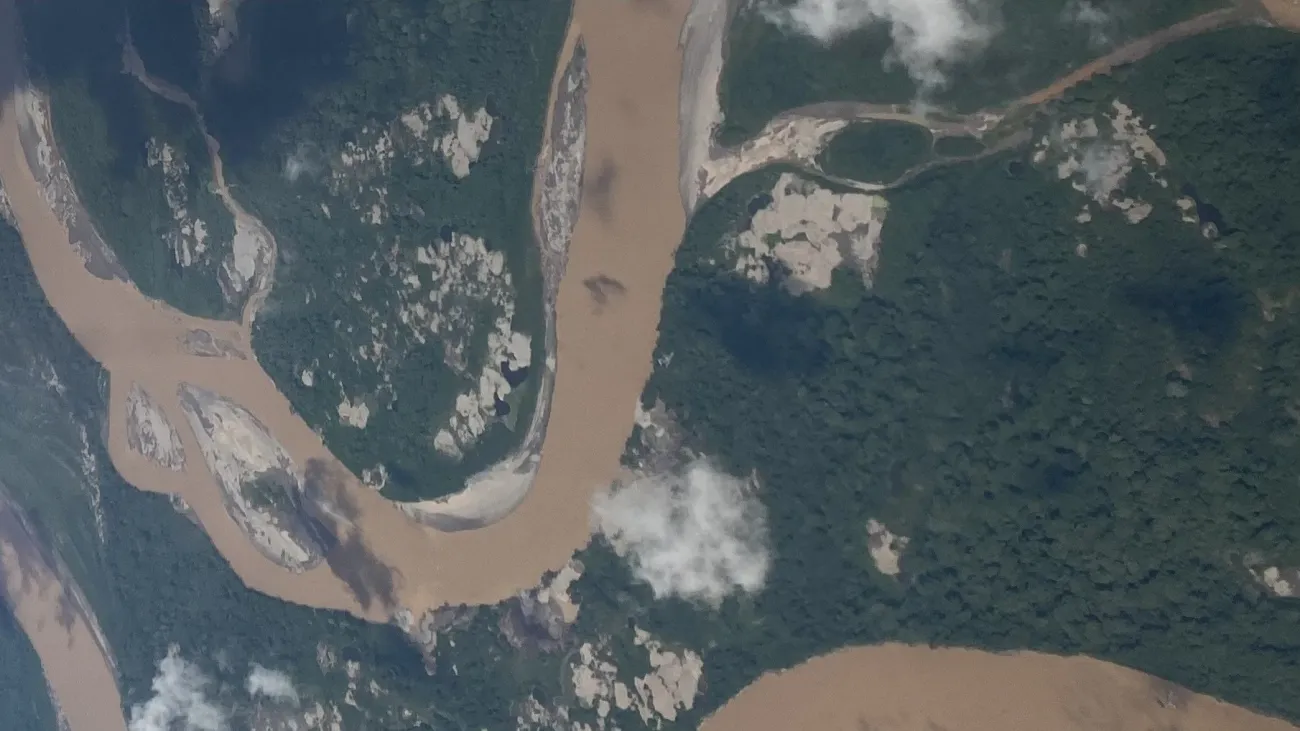
The research focuses on three Indigenous communities in Madre de Dios, Peru, a region that has become a global hotspot for artisanal and small-scale gold mining (ASGM). Over recent decades, external mining activity has transformed local landscapes, contributing to deforestation, disrupting traditional livelihoods and undermining Indigenous authority over land and resources.
In response to these changing conditions, some Indigenous communities have also turned to mining themselves.
Based on interviews, participant observation and fieldwork in Madre de Dios, the study finds that community mining is not only as a source of income, but also as a way to remain on ancestral territory in the face of mounting social and environmental pressures.
In Madre de Dios, this creates a profound tension. Mining helps some families earn a living and maintain a presence on their land after traditional livelihoods such as hunting, fishing and agriculture have become increasingly difficult. Yet mining can also contribute to the environmental degradation that threatens those same communities and landscapes.
Rather than trying to resolve this contradiction, the adaptation sovereignty framework seeks to make it visible.
Lena Easton-Calabria, lead author, said:
Small-scale mining is often discussed in terms of its environmental harm or illegality. This research shows that, for some communities, mining can also represent a strategic adaptation to environmental change and a means of maintaining a presence on their land amid external challenges to their territorial rights. The framework of adaptation sovereignty helps us understand the tensions inherent in environmentally harmful adaptive practices and underscores the importance of understanding the rationale behind these practices.”
The paper argues that adaptation is not only a process of coping with environmental change. It is also shaped by questions of self-determination, territorial authority and identity. The concept of adaptation sovereignty captures this intersection, highlighting how responses to environmental change can simultaneously be survival strategies and expressions of agency.
The research also found that community members often look beyond mining when describing the future. They spoke about new livelihoods in agriculture, aquaculture, ecotourism and forest-based enterprises, alongside stronger community ties and greater control over decisions affecting their territories.
The study argues that policies focused exclusively on environmental impacts or illegality risk overlooking the conditions that make certain activities necessary in the first place. Instead, understanding why communities adopt particular strategies may be essential to developing more effective and equitable responses to environmental change.
The paper was co-authored with Javier Pacaya Álvarez, a member of one of the anonymised study communities in Madre de Dios, Peru, and Professor Constance McDermott, Land, Society and Governance Programme Lead at the ECI. Together, the authors argue that responses to environmental change cannot be understood through environmental pressures alone but must also be understood in relation to land, livelihoods, and self-determination.
By introducing adaptation sovereignty, the research offers a new way of understanding how communities navigate environmental change under contested conditions. While developed through research in the Peruvian Amazon, the framework has broader relevance for examining how people around the world adapt to environmental pressures while seeking to shape their futures.
Read the full paper in Geoforum: Adaptation sovereignty: situated responses to environmental change