

At the height of the fashion for feathered hats, millions of birds were killed to supply a booming global trade in plumage. A new study involving Environmental Change Institute researcher Dr Diogo Veríssimo has examined what brought the trade into decline – and found that conservation campaigning was important, but was just one part of a much bigger story.
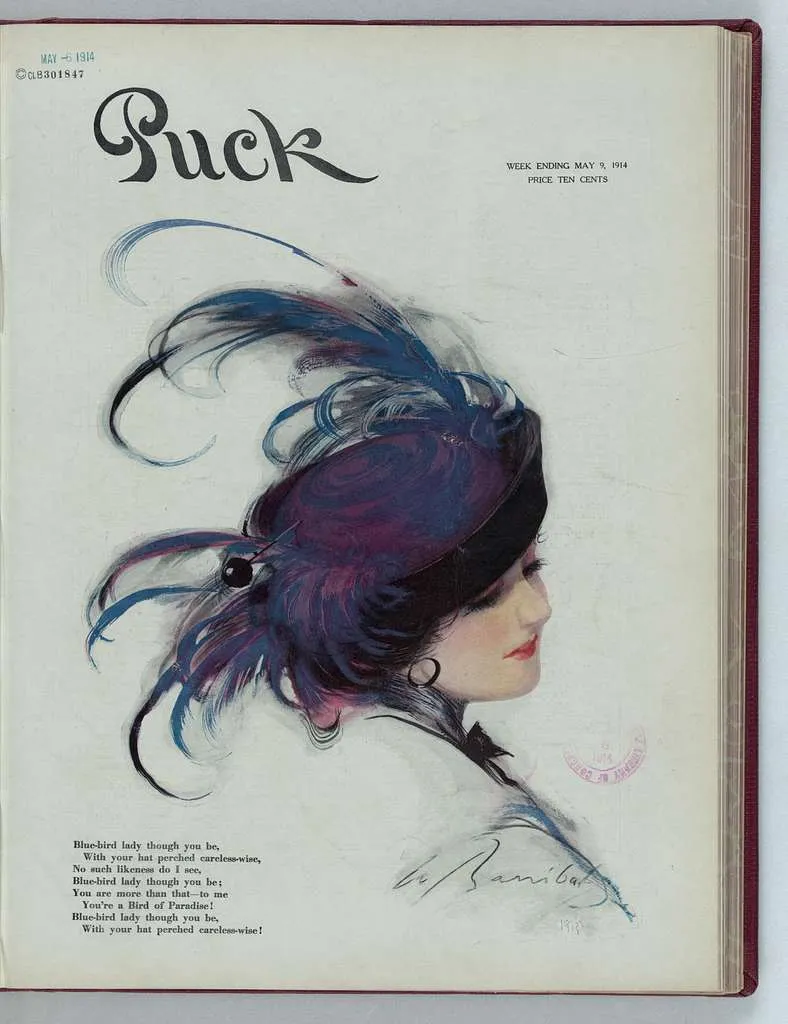
William H. Barribal, Blue-bird lady though you be, with your hat perched careless-wise, 1914.
In the 19th and early 20th centuries, exotic bird feathers were highly fashionable, particularly in women’s millinery. Hats could feature the feathers of birds such as egrets, or even the entire bodies of small birds such as hummingbirds.
Between 1901 and 1910 alone, more than 14 million pounds of exotic feathers were reportedly imported into the UK, worth almost £20 million at the time. The demand had serious consequences for wildlife, with plume hunting contributing to local extinctions and major declines in bird populations.
The Royal Society for the Protection of Birds (RSPB) was founded in response to this trade, with ending the use of exotic bird plumes in women’s fashion among its primary aims.
But while the trade had fallen dramatically by the middle of the 20th century, exactly what caused that change has remained difficult to establish.
The new study, published in Royal Society Open Science, brings together historical evidence and expert interviews to examine the different factors that contributed to the decline.
The researchers found that the change was not driven by a single event or intervention. Instead, several factors interacted over time, including changing fashion, changes in women’s lives, the First World War, international and UK legislation, growing concern about animal welfare and conservation, and campaigning against the use of feathers.
Dr Veríssimo, Lead of ECI’s Biodiversity and Behavioural Science Team (BBeST), and Research Fellow at Oxford’s Wildlife Conservation Research Unit (WildCRU), is a co-author of the study. He said:
It’s tempting to look for one reason why a major social change happened, but changes on this scale rarely have a single cause. Conservation campaigning was important, but it was happening alongside major changes in fashion, women’s lives, the First World War, legislation and broader social attitudes.”
From fashion staple to social taboo
Changing fashion was one of the strongest factors identified in the study. Ten of the experts interviewed identified fashion cycles as an important driver of the decline in feather use.
The fashions of the 1910s, for example, favoured a very different silhouette from those of the 1920s. Shorter hair, simpler styles and changing attitudes towards clothing and corsets all contributed to a shift away from the elaborate feathered fashions of previous decades.
The First World War also accelerated changes in women’s lives and clothing. Increased employment and more practical day-to-day lives created different expectations around fashion.
However, the war alone could not explain the decline. Feather imports increased again after the war, suggesting that other factors were needed to sustain the longer-term shift away from plumage.
At the same time, attitudes towards wearing feathers were changing.
Conservation organisations including the RSPB campaigned actively against the use of exotic plumes, highlighting the cruelty of the trade and its impact on bird populations. Campaigners used social pressure, prominent figures and the media to make feather wearing less socially acceptable.
The study found strong evidence that this campaigning contributed to the change in behaviour, particularly when combined with wider social changes.
The RSPB also pursued changes in policy, eventually contributing to the passage of the Importation of Plumage (Prohibition) Act in 1921. Seven of the experts interviewed ranked the Act as an important factor, although its precise impact is difficult to determine because feather imports had already begun to fall and increased slightly after the Act was passed.
International legislation also contributed to changes in the global trade, with restrictions introduced in countries including the United States affecting the supply and demand for plumage.
Timing mattered
The findings suggest that successful conservation campaigns do not necessarily operate in isolation. Advocacy can be particularly effective when it interacts with broader changes already taking place in society.
In the case of the feather trade, conservation campaigners were able to build public support and push for policy change while fashion, lifestyles and attitudes were already shifting.
The researchers argue that this offers lessons for current efforts to change behaviours that threaten wildlife. Dr Veríssimo added:
This case shows the importance of understanding the wider context in which conservation campaigns take place. Advocacy can help drive behaviour change, but its impact may depend on the social conditions and opportunities that exist at the time.”
The study also highlights the importance of maintaining pressure for policy change even when a harmful behaviour is already declining. While changing demand helped reduce the feather trade, legislation helped prevent the trade from simply recovering later.
Understanding why conservation interventions work
To investigate the causes of this historic change, the researchers used an approach called General Elimination Methodology Plus (GEM+), which combines expert judgement with historical evidence to assess the likely causes of major changes.
Sixteen experts from areas including fashion, conservation, industry and policy were interviewed, alongside analysis of historical sources including magazines, parliamentary papers and other literature.
The researchers say the approach could also be useful for evaluating conservation interventions where traditional methods such as controlled experiments are not practical, particularly when changes involve complex social and environmental systems.
For the feather trade, the analysis provides evidence that conservation advocacy made a meaningful contribution to a major shift in behaviour – but as part of a wider combination of social, cultural and political changes.
The case offers a reminder that understanding how different drivers interact can be just as important as identifying individual interventions when seeking to change behaviours that threaten wildlife.
The study was led by Sally Sinclair from the Durrell Institute of Conservation and Ecology at the University of Kent, with co-authors including Dr Diogo Veríssimo and Audrey Dickinson of the University of Oxford’s Department of Biology and the San Diego Botanic Garden.
Read the full study in Royal Society Open Science: When Feathers Fell from Fashion: Unpacking the End of the UK Plumage Trade