


Even if the world meets the Paris Agreement targets, sea levels will keep rising and Arctic permafrost will continue thawing — for hundreds of years. A new study published today in Environmental Research Letters reveals the scale of the challenge: stabilising these long-term impacts will require a net-negative carbon economy — removing more carbon from the atmosphere than we emit — for at least the next 250 years.
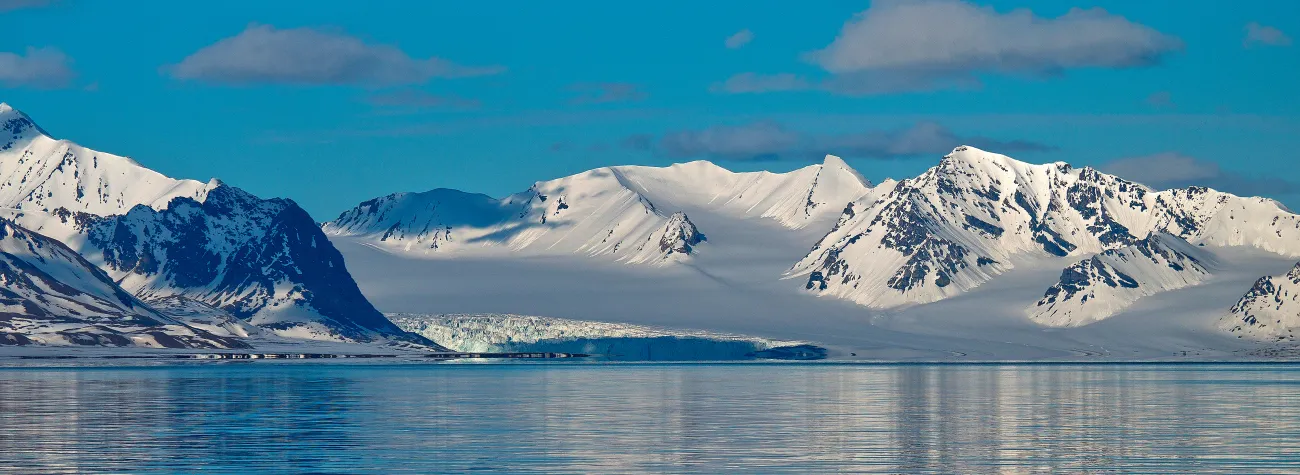
Glacier and Snowcapped Mountains, Oscar II Land, Arctic, Spitsbergen, Svalbard, Norway
New insights on long-term climate goals
Professor Michael Obersteiner, Director of ECI and Principal Researcher at the IIASA said:
This is the first paper to analyse the attainability of long-term Earth system goals such as sea-level rise. Even if we reach the Paris Agreement targets, sea levels will continue to rise. And carbon removal technologies are here to stay for at least the next 250 years, while we aim for net-zero emissions within the next 20–30 years. Right now, neither science nor policy circles fully recognise these facts.”
Study lead, Dr Johannes Bednar, former DPhil student at the ECI, and Research Scholar at IIASA, added:
The hardest part is transitioning to the net negative carbon economy. We lack mature technologies, the policy instruments, and international agreements on responsibility for net CO₂ drawdown. The good news is that once achieved, maintaining net negative emissions should become progressively easier, as removals account for a shrinking share of economic and energy activity.”
The study shows that climate policy based on temperature targets alone — such as keeping warming to 1.5°C or “well below” 2°C — doesn’t capture the full picture. Some impacts respond slowly to temperature changes. Even if global temperatures stabilise, sea levels continue to rise and permafrost continues to thaw, releasing carbon dioxide and methane that further accelerate warming. These so-called time-lagged impacts are effectively irreversible on human timescales:
- Sea-level rise threatens coastal cities, infrastructure, ecosystems, and low-lying island states, with damages projected in the hundreds of billions of dollars per year.
- Permafrost thaw, covering around a quarter of the Northern Hemisphere, releases greenhouse gases, destabilises buildings and roads, disrupts water systems, and could even release dormant pathogens.
While these impacts cannot be fully reversed, sustained large-scale interventions — such as carbon removal and ecosystem management — can help stabilise them and prevent further worsening.
Sustained carbon removal is essential
The researchers used a range of future climate and technology scenarios to see how long it would take to halt these impacts. Across all scenarios, they found that net-negative carbon emissions would need to continue for centuries, even under optimistic assumptions about renewable energy, carbon capture, and ecosystem management.
Delays in reducing emissions now not only increase the peak level of impacts but also make future outcomes more uncertain and harder to manage. The study highlights that both immediate emission reductions and long-term carbon removal are essential, as each plays a different but complementary role in stabilising impacts.
Legal and ethical dimensions
The study builds on a 2025 advisory opinion from the International Court of Justice (ICJ), which confirmed that countries have binding obligations to prevent significant harm from climate change — including harm that unfolds far into the future. Ongoing sea-level rise and permafrost thaw clearly meet this definition of “significant harm.” Preventing that harm may imply long-term international responsibilities for carbon dioxide removal, extending across generations. This raises important questions about fairness, governance, and how obligations could be shared between countries with different capabilities and historical responsibilities.
The research team
The study showcases ECI’s expertise in long-term climate risks, adaptation, and policy-relevant science. Dr Bednar led the climate modelling and analysis. Professor Obersteiner, guided the overall study design and explored its implications for long-term climate responsibility. Professor Jim Hall, Professor of Climate and Environmental Risk at ECI and Director of the Oxford Programme for Sustainable Infrastructure Systems (OPSIS), provided supervision and expertise on climate risk and infrastructure. The team also included Dr Artem Baklanov and Dr Thomas Gasser of IIASA, and Dr Justin Macinante of the University of Edinburgh who supported the modelling and analysis.
Why this matters now
The choices made in the next few decades will shape climate risks for hundreds of years. Meeting the Paris targets is necessary but not sufficient to stabilise some of the most dangerous climate impacts.
As the study shows, preventing long-term harm requires early and sustained action, and the development of institutions capable of managing climate responsibility across generations. In short, limiting warming is only the first step — stabilising the Earth system itself will be a long-term challenge spanning centuries.
Read the full article in Environmental Research Letters: Stabilising time-lagged climate impacts requires net-negative emissions for centuries