

Restoring seabird populations and native vegetation could help low-lying tropical islands build resilience to rising seas, according to new research involving Professor Yadvinder Malhi of the Environmental Change Institute and Leverhulme Centre for Nature Recovery.

The international study, led by researchers at Lancaster University and published in Science Advances, brings together data from 28 tropical islands across the Indian and Pacific oceans to explore how seabirds, forests and surrounding coral reefs interact to support the natural processes that help islands adapt to environmental change.
Tropical atoll islands are particularly vulnerable to sea-level rise. But the research shows that restoring parts of their natural ecosystems could strengthen three processes that are important for their resilience: coral reef growth, sediment production and the stabilisation of island soils by plant roots.
Seabirds play an important role by bringing nutrients from the open ocean onto islands, with effects that extend to surrounding marine ecosystems. The researchers found that islands with seabirds had faster coral reef growth, while native vegetation supported greater root production and helped stabilise island soils.
On rat-free islands, lagoonal reef accretion rates were around 1.8 times higher than those around rat-infested islands, while ocean-facing reef accretion rates were around 2.5 times higher. The researchers estimate that, under a 2°C warming scenario, reef accretion on rat-free lagoonal reefs could closely keep pace with projected sea-level rise through the end of the century. At the study location, lagoonal reef accretion on rat-free islands was around 5.92 mm per year, compared with projected sea-level rise of around 6 mm per year under this scenario.
The study also found that native vegetation was particularly important for stabilising island soils. Fine root length was 4.6 times higher in areas with high native vegetation cover than in areas with low cover, highlighting the potential benefits of restoring native forests in places where they have been replaced by coconut plantations or other land uses.
Professor Yadvinder Malhi, Director of the Leverhulme Centre for Nature Recovery at the University of Oxford, said:
The study shows beautifully how atolls are an intimately interconnected island-reef system, a geo-ecological system. Restoring and boosting the wildness of these islands through seabirds and native vegetation helps these islands to adapt to global change.”
The findings point to restoration as one way of strengthening the natural processes that help vulnerable islands respond to climate change. Measures such as eradicating invasive rats, restoring native vegetation and managing fisheries could help to rebuild these interconnected ecosystems.
Read the full paper in Science Advances: Seabirds and native vegetation drive ecosystem processes that support atoll island resilience
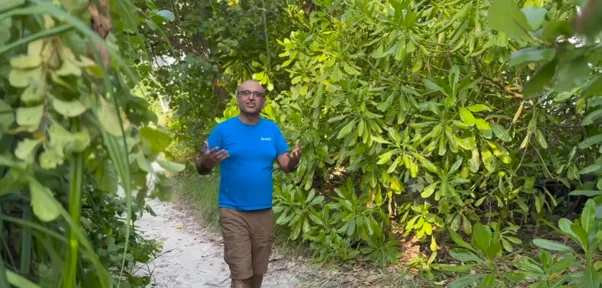
A short video filmed in the Maldives explains the science behind these connections: watch the video on YouTube.