
Professor Yadvinder Malhi, Programme Leader for Ecosystems and Biodiversity at the Environmental Change Institute (ECI) and Director of the Leverhulme Centre for Nature Recovery, has shared reflections from his time at COP30 in Belém.
A city he describes as “a beloved, slightly dilapidated aunt, full of stories, a little chaotic and dishevelled, but ultimately hospitable. Her edges are frayed but her welcome is generous.”
His blog offers both a personal return to a formative landscape and a clear-eyed assessment of where tropical forest action now stands on the global stage.
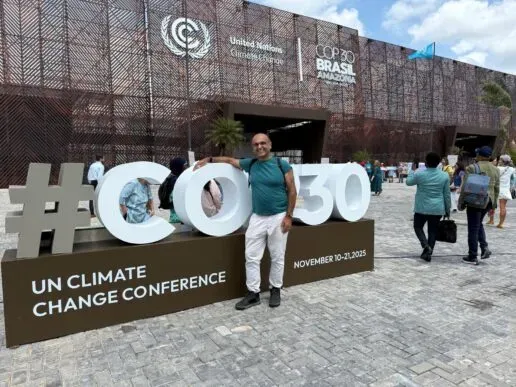
In Belém—set at the mouth of the Amazon and surrounded by what Yadvinder calls “the great green ocean of leaves”—tropical forests were at the heart of COP30. Across negotiation rooms, pavilions, protests, and public events, he observed a convergence of science, activism, policy, and culture that placed forest protection and community leadership centre-stage. New science reports for the Amazon, Congo Basin, and Borneo—major international collaborations involving hundreds of researchers—highlighted how these ecosystems sit at a planetary crossroads. Their message was unequivocal: tropical forests are essential to climate stability, biodiversity, and the world’s ecological heartbeat, yet remain under accelerating pressure.
One of the most striking shifts, Yadvinder notes, is the increasing recognition of Indigenous Peoples and Local Communities as central custodians of forest health—a change reflected in emerging forest finance proposals such as Brazil’s Tropical Forest Forever Facility. As he writes:
The future of tropical forests depends as much on justice and governance as it does on technology and finance.”
His week in Belém was also a return to old research grounds, reconnecting with colleagues across Brazil and witnessing firsthand signs of hope: a sharp drop in Amazon deforestation and fires, local scientists leading crucial policy conversations, and renewed political momentum for forest recovery.
Yet the blog also urges realism. The path forward, he writes, demands what he calls hope as a discipline:
I spoke about hope, not as a mood but as a discipline, citing the American activist Mariame Kaba. ‘Hope is something that needs practice. It is a state of action rather than a state of being’.”
This thoughtful piece brings together science, memory, politics and philosophy, offering a rare, grounded perspective from inside and outside the COP halls.
Read Prof Malhi’s full reflections from the global event: COP30 at the City at the Mouth of the Green Ocean