
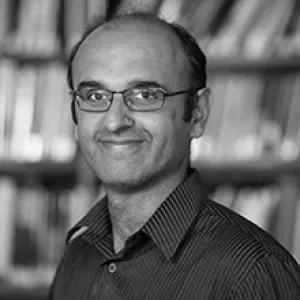
Professor Yadvinder Malhi of the Environmental Change Institute (ECI), University of Oxford, has been formally presented with the Ramon Margalef Prize in Ecology at a ceremony held at the Palau de la Generalitat in Barcelona.
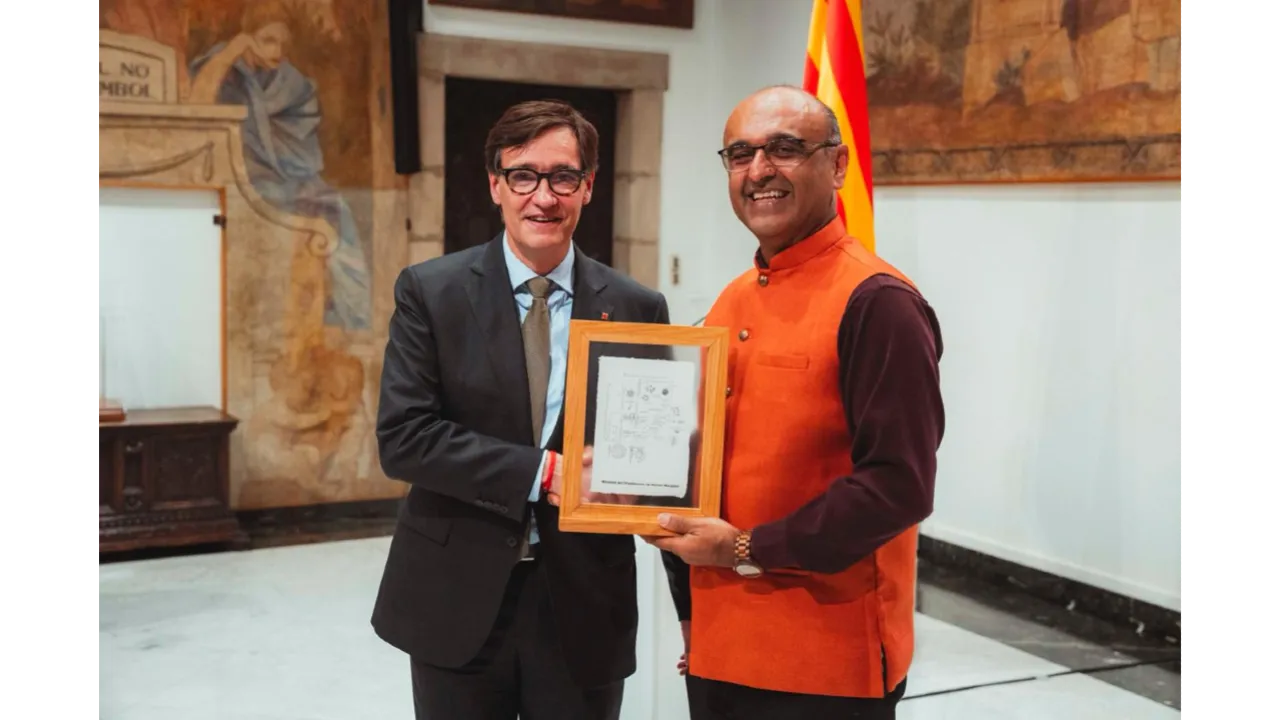
Salvador Illa, President of the Catalonia Government and Professor Yadvinder Malhi of the Environmental Change Institute and Leverhulme Centre for Nature Recovery
The award, one of the world’s foremost honours in ecological science, is conferred annually by the Government of Catalonia in recognition of an exceptional scientific career or discovery in ecology or the environmental sciences. Professor Malhi, who is the Ecosystems and Biodiversity Programme Lead at the ECI and Director of the ECI’s Leverhulme Centre for Nature Recovery, was selected for his pioneering contributions to the integration of ecosystem ecology into Earth system science, particularly through his work on tropical forests and long-term ecological research networks across the tropics.
In presenting the award President Salvador Illa of the Government of Catalonia thanked Prof Malhi for “his work to understand the complexity of our planet and contribute to better protecting it.”
The jury highlighted Malhi for his approach to the ecological complexity of tropical forests, skilfully combining different methods and progressively integrating functional and biodiversity perspectives. Thus, it considered that his ability to establish long-term research areas and networks around the world is exceptional, providing data that allows us to understand the dynamics of tropical forests under human pressure and changing established points of view.
In his address, President Salvador Illa reflected on the importance of science and its role in shaping a sustainable future. He remarked that “science is synonymous with hope” and that “the model of human progress must be compatible with respect for the environment, with territorial balance and with social justice.”
Accepting his award Prof Malhi said:
We live in a world of accelerating change — ecological, social, and technological. And yet, beneath all that change, the same fundamental laws hold: that life energy drives transformation, and information gives it pattern and meaning.
"Margalef understood this beautifully. He saw ecosystems as entities that, over time, accumulate both information and organisation.
"It is also wonderful to see this award as a signal of the strong support of the Catalan government for ecological science — and to know that the President himself is deeply committed to using science and evidence as foundations for a sustainable future for Catalonia.
"That commitment sends a powerful signal, not only to scientists, but to societies everywhere: that knowledge, when guided by humility and imagination, can help us shape a flourishing world.
"As I accept this award, I do so with enormous gratitude — to the Generalitat de Catalunya, to the Jury of the Ramon Margalef Prize, to my fellow ecologists here and around the world whose work continually inspires me, and above all, to Ramon Margalef himself, whose ideas continue to illuminate the path ahead.
"He showed us that our role, as scientists and as citizens, is not only to study those flows, but to live wisely within the flows of nature.
"If we can do that — if we can align our systems of knowledge, economy, and society with the deeper logic of the living world — then we might yet find, even amid disturbance, the seeds of renewal.
“We might rediscover, as Margalef did, that complexity is not a problem to be solved, but a source of beauty, vitality, and endless possibility.”
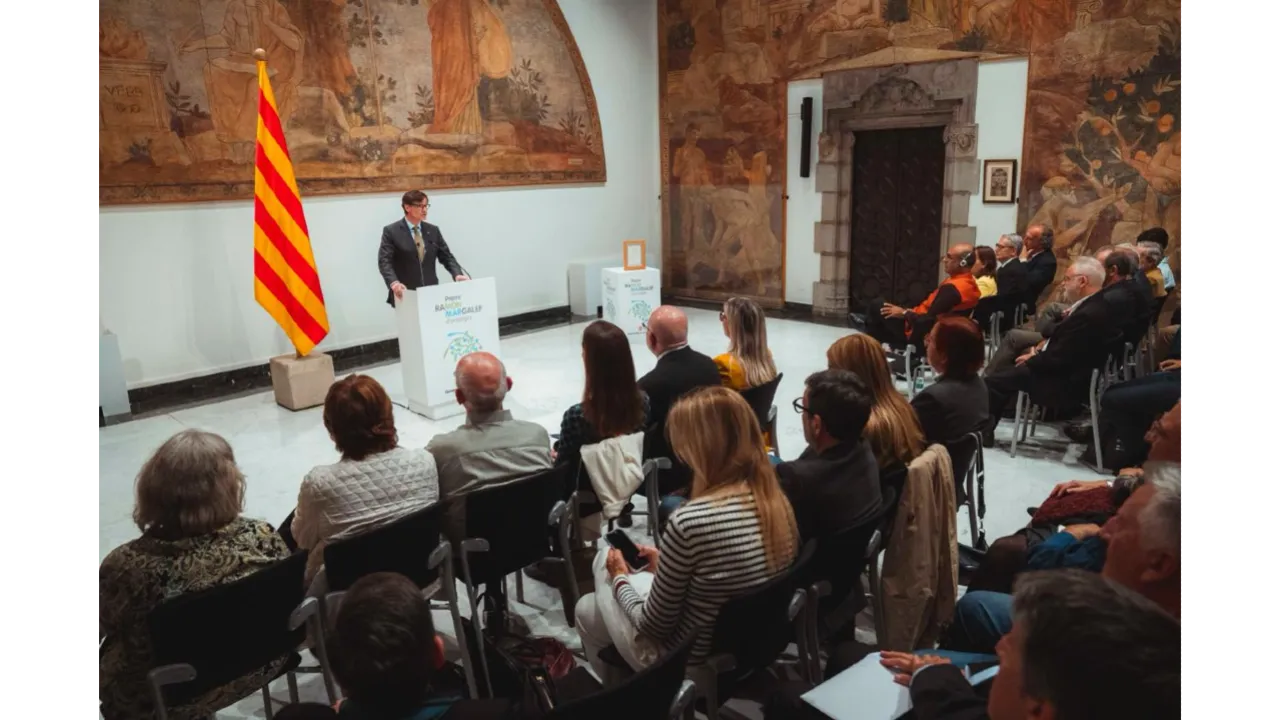
During his address the President underlined “the need for governments to make decisions based on knowledge and scientific rigour,” adding that “resistance to science is dangerous and selfish because it puts health, the landscape and shared prosperity at risk.” He continued, “In Catalonia we are clear: Catalonia chooses science and has a pro-science government.”
President Illa also emphasised “The collective responsibility to take care of natural heritage and to prepare ourselves to face the effects of climate change. A country that takes care of its natural heritage is a country that takes care of its well-being and prosperity.”
He concluded by describing the Ramon Margalef Prize as “a call for hope and to turn the climate challenge into an opportunity to build fairer societies that are better adapted to the planet Earth that we share.”
Read Prof Malhi’s acceptance speech in full.
Read Prof Malhi’s blog following his visit to Barcelona.
Read more on the award ceremony on the Government of Catalonia website.