

Fuel subsidy reform is economically sensible but politically tricky. Former MSc student Pree Bharadwaj, alongside supervisor Dr Stefania Innocenti, studied public responses during a live Malaysian reform, showing how different framings — emphasising its redistributive or environmental benefits — can increase support and reduce opposition. Their findings offer practical lessons for governments on communicating policy effectively.
Fuel subsidy reform is often described as good economics paired with difficult politics. While the economic case for reform is well established – fuel subsidies are costly, regressive, and environmentally harmful – many governments struggle to implement change without triggering public backlash.
Malaysia offers a particularly instructive case. For more than a decade, successive governments have recognised the need to reform fuel subsidies, yet progress has been uneven. Understanding why reform stalls, and what might help it succeed, became the starting point for my dissertation during the MSc in Environmental Change and Management (ECM).
In this blog, I discuss the motivation behind the study on Securing public support for fuel subsidy reform: Experimental and policymaker insights from Malaysia, the rare policy window that enabled real-time, policy-relevant research, and the mixed-methods approach we used to examine how governments can communicate reform more effectively. I also reflect on how my MSc research has shaped my work beyond ECM, as I now contribute to sustainability reporting and climate adaptation finance at the Securities Commission Malaysia.
Why fuel subsidies, and why Malaysia?
Fuel subsidies lower the price consumers pay for petrol or diesel by shifting costs onto public budgets. While often introduced to protect households from price volatility, they disproportionately benefit higher-income households, encourage fossil fuel consumption, and crowd out spending on social programmes and climate action.
As a Malaysian, these tensions have played out for at least the last 12 years. Reform was widely acknowledged as economically sensible, yet politically risky. I wanted to understand why, and, more importantly, what could be done to advance reform in a way that was both environmentally sound and socially credible.
Finding the research question as an ECM student
During my MSc in Environmental Change and Management (ECM), attending lectures by visiting researchers at the ECI helped sharpen my interest. An early lecture by Neil McCulloch, whose work focuses on the political economy of reform, was particularly formative. It reinforced a central but often overlooked point: technically sound subsidy reform often fails not because the economics are wrong, but because political and social dynamics are misunderstood.
Through discussions with my supervisor, Dr Stefania Innocenti, this crystallised into a simple but consequential research question: How should governments communicate fuel subsidy reform to secure public buy-in?
A rare policy window: Malaysia announces reform
Shortly after these early conversations, in December 2023, the Malaysian government announced that it would introduce a petrol subsidy reform. Crucially, this created a rare policy window — a period after announcement but before implementation — when public opinion was still forming and policy details were being debated.
I entered the MSc in ECM committed to producing research on Southeast Asia, and Malaysia in particular. As an early career researcher, this was a unique opportunity – it allowed us to study public responses during a live policy process.
A mixed-methods approach, and why it mattered
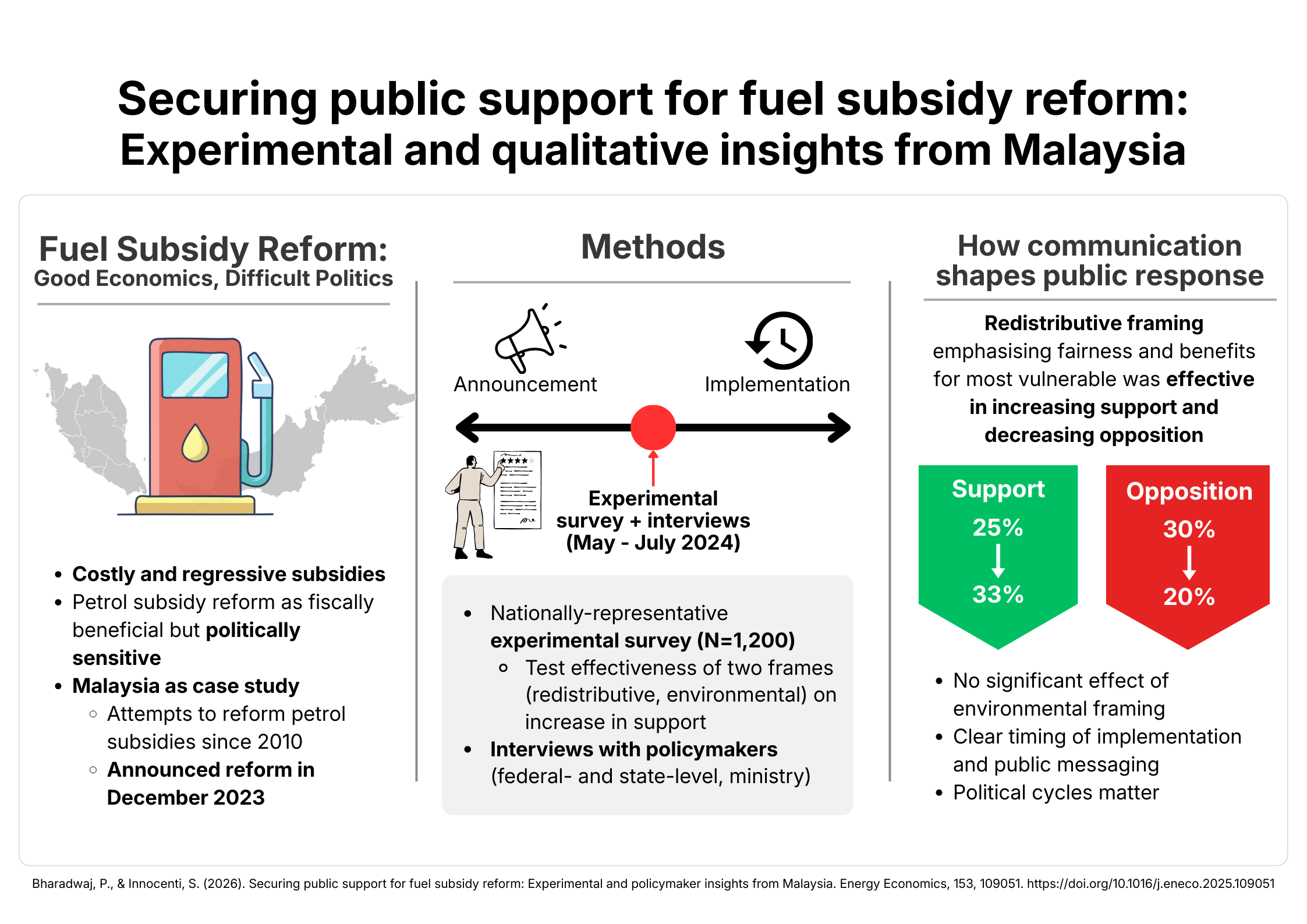
We conducted a nationally representative survey experiment with over 1,200 Malaysians, which was meant to test the effectiveness of two different framing interventions in increasing public support for the announced reform.
After all respondents received the same basic information about the reform and were asked to indicate their support for it, they were randomly assigned to one of three groups: Control, Redistributive, Environmental. The Control group was given no extra information, the Redistributive group were told how the reform would benefit lower-income households, and the Environmental group were told about the environmental benefits of reducing fuel use. After the interventions, we elicited support again to test the effect of the framings on support levels.
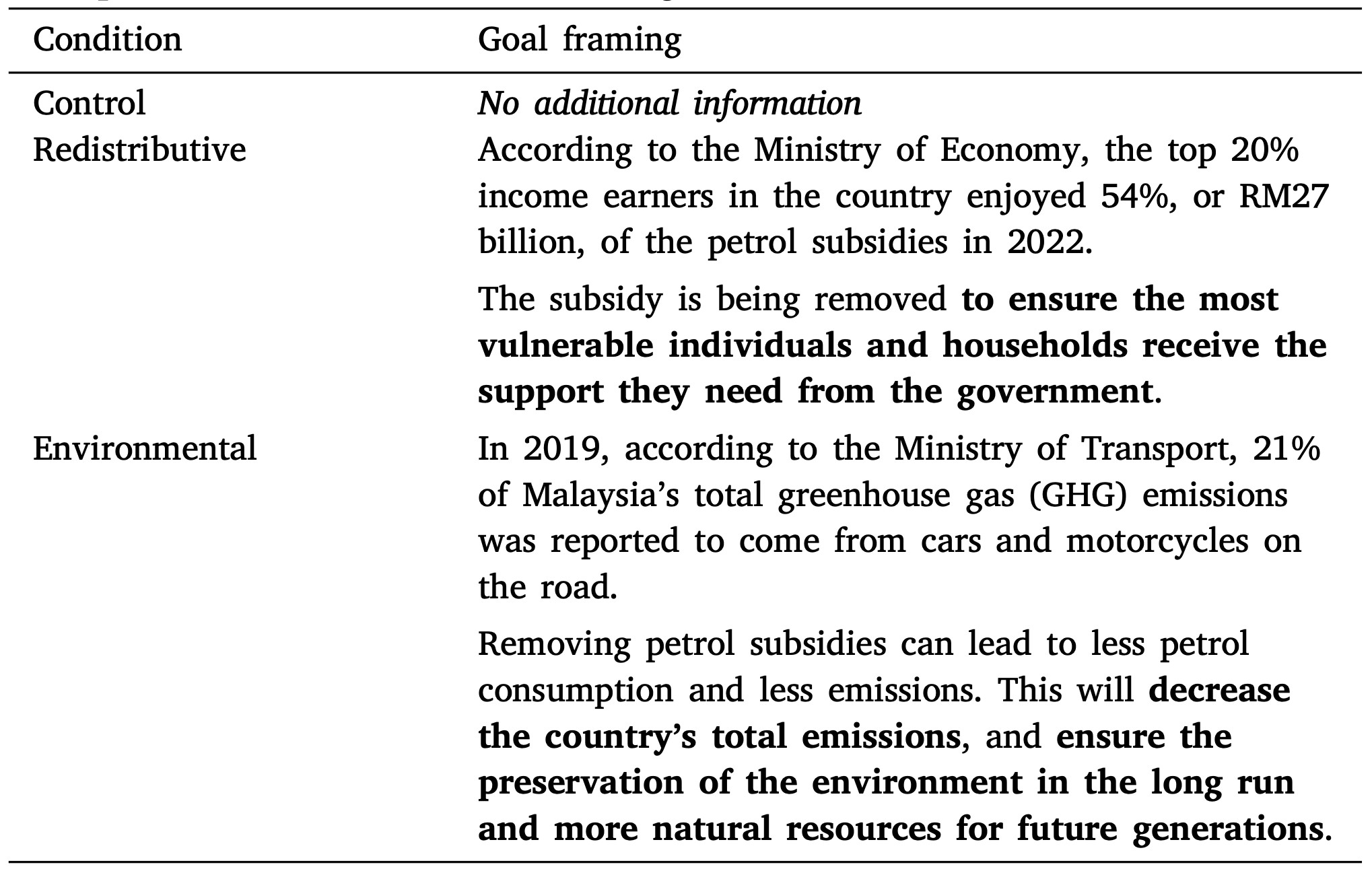
Text provided to respondents in the Control, Redistributive, and Environmental groups
This allowed us to causally estimate how specific messages affected public support and opposition. This study was made possible with the support from ECI, Yayasan Khazanah, and Hertford College.
We launched the survey at a specific time, allowing us to capture reactions during a real implementation window rather than after the reform was implemented. To complement this, we interviewed policymakers involved in or familiar with the reform process. These interviews helped validate the survey results and shed light on how communication strategies are shaped by uncertainty, political risk, and electoral cycles.
ECM emphasises interdisciplinarity, and I was intentional in what I wanted to draw from the dissertation process: I wanted to strengthen my quantitative skills in economics and statistics while retaining, and expanding, depth through qualitative methods. We fielded the experimental survey in May 2024, and I spent that summer back in Malaysia, moving between Parliament, local state assemblypersons’ offices, ministries, and Zoom calls to interview policymakers and understand the realities of reform on the ground.
Together, these methods allowed us to connect public opinion with the realities of policymaking.
Key findings and policy implications
Several findings stood out with key takeaways for policymakers.
| Key findings | Policy implications | |
|---|---|---|
| 1 | Framing reform around fairness and redistribution increased public support by seven percentage points (from 25% in control to 33%). When people understood how savings would be redirected (i.e. towards more vulnerable households), support increased meaningfully. | Communicate reform through a clear narrative that explains who benefits and how savings are used. |
| 2 | Redistributive framing reduced opposition even more sharply (from 30% to 20%). | Reduction in opposition is critical, as a relatively small but vocal group of dissenters can derail reform through protests or political pressure. |
| 3 | Policymakers emphasised the importance of clear and credible communication. Poorly timed or ambiguous messaging can quickly erode trust, particularly in politically sensitive contexts. | Transparency and communication are not optional. Clearly explaining what is changing, when it will happen, and how people will be affected is critical for maintaining trust during reform. Uncertainty around timing or implementation can quickly undermine public confidence. |
| 4 | Policymakers consider electoral cycles when communicating reform. | Align reform timelines and communication strategies with political realities. |
From dissertation to publication
After completing the MSc in ECM in September 2024, I was awarded one of two ECM Dissertation Prizes, which enabled me to further develop this research. Working closely with Dr Innocenti, we refined the analysis and positioning of the paper for submission.
I cannot underestimate the richness of a vibrant academic community. The dissertation in its revised paper format was shared with classmates, fellow researchers at ECI and SSEE, as well as at other institutions. They helped me identify pitfalls and areas for improvement.
After a stringent peer-review process, the manuscript was recently published in the Journal of Energy Economics, a leading, policy-relevant journal that frequently features work at the intersection of economics, energy, and public policy.
Post-ECM: Applying the Master’s to Malaysia’s policy work
After finalising the journal submission, I joined the Securities Commission Malaysia, the country’s capital market regulator. I now work on mandatory sustainability reporting requirements and efforts to facilitate climate adaptation finance. This involves implementation of the ISSB Standards through Malaysia’s National Sustainability Reporting Framework, as well as exploring avenues to catalyse and increase finance towards sustainability, including adaptation.
The core lessons from this research continue to shape my work. Grounding policy in climate science, listening carefully to those most affected, and reducing uncertainty through clear communication are as relevant in sustainable finance regulation as they are in energy reform. Regular engagement with market participants provides a form of evidence that mirrors the research process itself: understanding constraints and designing measures that are robust and implementable for the environment, society, and the economy.
For me, this research process reflected what ECI does best: enables its students to engage with urgent policy questions, at moments when evidence can meaningfully shape outcomes.
Read the full open access article in the Journal of Energy Economics: Securing public support for fuel subsidy reform: Experimental and policymaker insights from Malaysia