

Urban trees are often seen as the go-to solution for cooling cities and improving quality of life. But new research shows that native grasslands can be just as than urban forests.
A study of Johannesburg, South Africa, led by Camilla Hyslop, DPhil student at the Environmental Change Institute (ECI), compares how different types of urban nature affect heat, biodiversity, and human well-being across the city. The findings challenge common assumptions about “green” cities and offer important lessons for urban planning in fast-growing cities worldwide.
Camilla carried out the study with Dr Nicola Stevens, Senior Researcher at the ECI and also Zander Venter, Senior Research Scientist, at the Norwegian Institute for Nature Research in Norway. All three researchers are originally from South Africa, and brought local insight to the study, helping to interpret the city’s complex urban ecosystems.
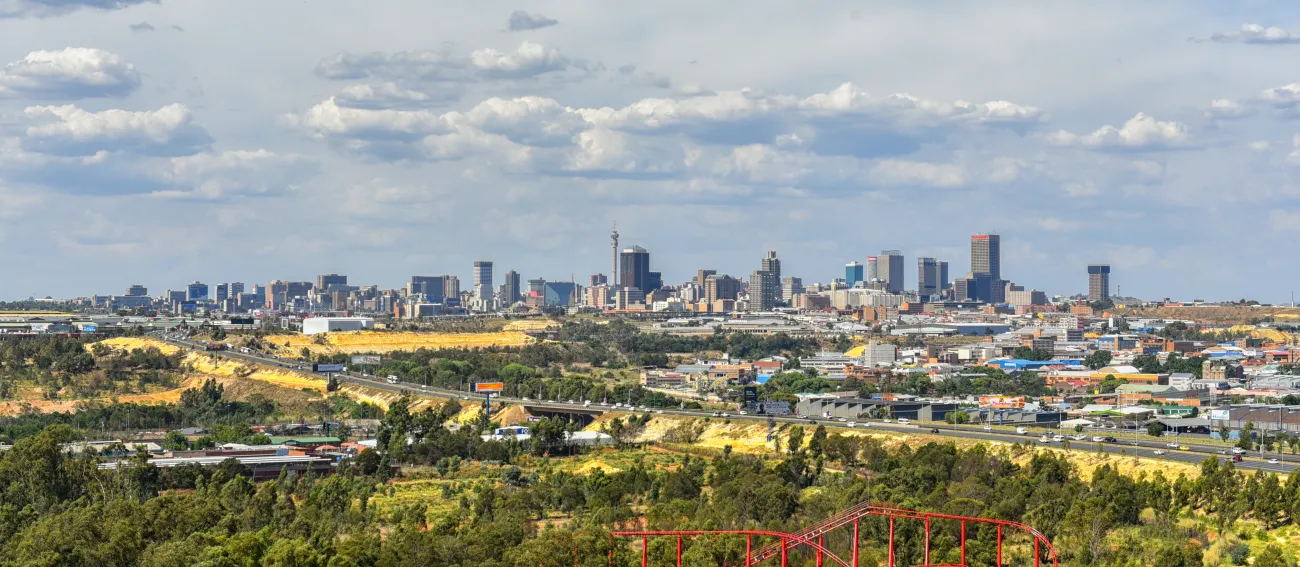
Johannesburg cityscape, Gauteng, South Africa
Three kinds of urban nature — and very different outcomes
The researchers examined all 135 wards (neighbourhoods) in Johannesburg, grouping them into three broad ecosystem types:
- Native ecosystems — largely natural Highveld grasslands on the city’s edges
- Novel ecosystems — human-made green spaces, including gardens and the city’s extensive planted tree canopy
- Urban-industrial areas — dense, built-up parts of the city with little green space
They then compared how these ecosystems perform across three key goals of nature-based solutions: cooling the city, supporting biodiversity, and contributing to people’s everyday needs.
Camilla Hyslop said:
In urban settings, we should be thinking more widely about what ‘nature’ we use for nature-based solutions. While trees offer indelible benefits, native ecosystems, like Johannesburg’s grasslands, have as much a part to play as the urban forest.”
Native grasslands are the coolest parts of the city
One of the study’s clearest findings is that both native grasslands and tree-covered areas are significantly cooler than heavily built-up neighbourhoods. Surprisingly, the coolest areas of Johannesburg were those dominated by native grasslands, which were on average:
- Nearly 2°C cooler than urban-industrial areas
- Slightly cooler even than tree-dominated neighbourhoods
This matters because small temperature differences at the neighbourhood scale can reduce heat stress and health risks, especially during heatwaves. The result challenges the idea that trees are the only effective way to cool cities. In Johannesburg’s context, open, grassy ecosystems also play a crucial role in regulating heat.
Read the full study in the Journal of Environmental Planning and Management: Comparing the benefits of native and novel ecosystems as urban nature-based solutions: a case study of Johannesburg, South Africa