

Ethiopia has inaugurated the continent’s largest hydroelectric dam in a high-profile ceremony attended by senior officials and international representatives.
While the project marks a major milestone for Ethiopia’s energy ambitions, questions persist over its environmental consequences, the impact on local communities, and the future of regional cooperation over shared water resources.
Speaking on BBC Newshour, Dr Kevin Wheeler, a Research Associate with the OPSIS team at the Environmental Change Institute, explained why the project has become such a source of contention.
You can listen to the full interview on BBC Newshour (starting at 35:40). Available for 24 days from broadcast.
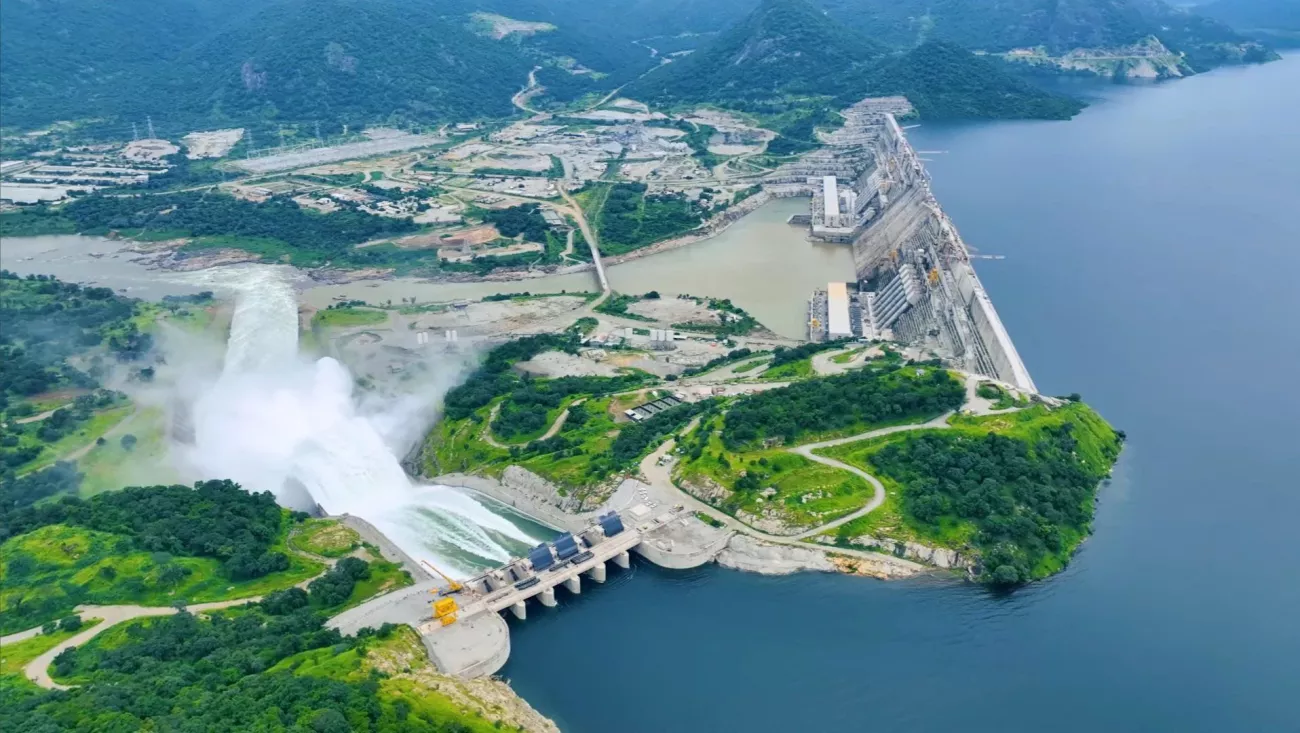
Now leaders from across Africa have joined big crowds in Ethiopia attending the inauguration of Africa’s biggest hydroelectric project. The inauguration featured lighting displays of drones as well as music, it was broadcast live by state TV from the site in Western Ethiopia.
The Grand Ethiopian Renaissance Dam on the Blue Nile doubles Ethiopia’s capacity to produce electricity. It faced strong objection from Egypt and from Sudan over concerns that their share of Nile water would be affected. Ethiopian Prime Minister Abiy Ahmed said the mega dam was a great achievement not only for Ethiopia but for all black people. The country’s permanent representative to the United Nations is Ambassador Tesfaye Yilma Sabo in New York.
This dam, in the first place, it addresses the energy poverty situation in Ethiopia. We have about 60% of our population not having access to energy. So, it will make a big difference when this energy system comes online. It will make a big difference in the lives of our people. On top of that it’s a clean energy, it’s renewable so that’s a bit plus as well. So, it means a lot for the economic development of Ethiopia, for the lives of ordinary people. It ticks every aspect of life in my country."
But the Egyptian Foreign Minister has described the dam as an existential threat to his country. That’s an assessment shared by Abbas Sharaky, a Professor of Geology and Water Resources at Cairo University.
So, the Ethiopian Renaissance Dam is filled right now by about 64 billion cubic meters of water. This water used to flow to Egypt, so now it is stored in Ethiopia, so this is a big harm for Egypt.
"The Nile River is the only source of this water in Egypt, so we are a poor country in terms of water and we are going to be severe water deficiency."
To explain this row and the potential impact of the dam on all the countries involved, we turned to Dr Kevin Wheeler from the Environmental Change Institute at Oxford University here in the UK. He has seen the Grand Ethiopian Renaissance Dam for himself.
The primary dam is about 145 or 150 meters in a construction along the Blue Nile, and then there's a secondary structure called a saddle dam, which is a very long, low elevation dam that helps the reservoir retain a lot more water.
The dam is very impressive, it's quite a feat of engineering, it hasn't been done in that section before at that scale. From a physical point of view, it is definitely slated to increase the energy potential of the country substantially, up to doubling the amount of energy that Ethiopia currently generates.
And it means putting very poor people on the grid, eliminating the use of dangerous indoor stoves, etc?
Well, that's certainly one of the advantages that requires having transmission lines to a lot of the villages throughout the country. That's another engineering feat to be able to provide that electricity around, it's one thing to build the plant, it's another thing to be able to get the energy to all the places that need it, and that's a parallel investment that Ethiopia has been taking part in, one that will continue for many, many years to come to try to reach all these areas.
Sudan and Egypt are downstream, they say it's their water too, what are their concerns?
Well, the concerns are very different between the two countries. Sudan sits directly below the dam, their Roseires Dam is only about 100 kilometers downstream of the GERD structure, so they're very concerned about how the dam would be operated on a day-to-day basis.
In particular, if too much water is released unexpectedly, it could have safety implications for their own dams and downstream through Khartoum, if any of the dams were to fail.
So, Sudan is very keen on having good information from Ethiopia on how they're going to operate the dam on a day-to-day basis and what their plans are. On the other hand, Egypt is primarily concerned with what the implications are during dry conditions, to make sure that Ethiopia is not holding back water when Egypt needs it the most, if the dam could operate in a way that could be potentially beneficial for Egypt or potentially harmful for Egypt.
Sudan and Egypt are downstream, they say it's their water too, what are their concerns?
Yeah, that's certainly true. There's a couple different factors, both the changing supply and the changing demand. Increasing populations in all of the areas means that Egypt will continue to be under significant water stress.
They always have been and they will be more so in the future. At the same time, climate change is having a lot of effects. However, most of the studies indicate that the Nile is probably going to be yielding more water in the future rather than less water.
However, there is certainly chances for longer dry periods and longer wet periods as the variability is expected to increase.
There has been talk of future war. Egypt and Ethiopia are keen to downplay it. But is it a concern, the possibility, the risk?
Well, there's a lot of scholars that study that and overwhelmingly the evidence says that water is not a cause for war. It's more often a reason why countries come together to try to work out their problems.
Now, the Nile has often been a quintessential risk where you have the more powerful country downstream at risk of the upstream country developing. So the rhetoric has been very strong about this.
But historically speaking, for water to be the sole cause of a conflict is pretty rare.
A lot is hinging, it strikes me, on this new facility, this new dam, being managed well in the future.
Yeah, absolutely. How the reservoirs operated for many years to come will be a major point of concern for the downstream countries. In particular, what happens during a drought condition.
Now that the dam is full, the risk has actually gone down significantly from during the period when it was being filled. And now the concern really is when there is a drought period, will Ethiopia release some of that water to help relieve some of the pressure on Egypt or will they maintain their dam is full?
And even more of a concern is when a drought is over, how would the two reservoirs, the Ethiopian Dam and the Aswan High Dam, refill their reservoirs in a unilateral or some type of inequitable way?