
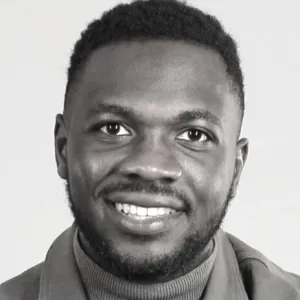
Former ECI MSc student Junior Mbangala credits his time on the ECI’s Environmental Change and Management (ECM) masters degree for laying the foundation for his research career. Building on the skills, mentorship, and inspiration he gained at the Environmental Change Institute, Junior has gone on to win a major prize from the Royal Geographical Society and is currently undertaking a DPhil in Sustainable Urban Development at the University of Oxford.

Junior at the Royal Geographical Awards ceremony
To set the scene, I have to go back to 2016, when I left Belgium, where I was born and raised, and started travelling the world. Having played football at the highest national level since the age of 14, leaving my home country set me on an international path that exposed me to the realities of the world. From a young age, outside the comfort of my family, I came face to face with the persistent inequalities that exist in the world we live in. I've come to realise that the world can be confusing and sometimes disorientating. I've seen that justice isn't always done, not because it can't be done, but because its path rarely leads first to those who deserve it most.
I first decided to study economics, convinced it held the keys I needed to understand if I was ever to confront social inequality. While studying economics, I quickly realised that the environmental issues that interested me were not always addressed, and when they were, it was often through the prism of economic gain rather than environmental value. My years in the world of sport taught me perseverance and the importance of constant questioning. This habit of constant questioning has guided me throughout my studies, allowing me to construct and deconstruct the sciences that I was taught, and pushed me to ask myself questions that deeply interested me, and the path that truly mattered to me.
Being accepted into the ECM programme at the University of Oxford was a dream come true. Oxford has been a place of encounters and inspiration, shaping the academic journey I aim to pursue. There, I have met some fascinating researchers and inspiring academics who not only nurtured my passion for research but also encouraged me to pursue work that challenges me as much as it interested me.
As I write this blog, my thoughts turn to Brenda Boardman, whom I can never thank enough for inspiring and guiding me when I first became interested in Energy Poverty. Thanks to Brenda, I immersed myself in research on a subject I didn't know anything about. Her support led me to undertake my master's dissertation on Energy Justice in Belgium and the case of Solar PV subsidy policies. Moreover, thanks to the kindness and rigour of my brilliant supervisors at the Environmental Change Institute (ECI), Tina Fawcett and Bryony Parrish, I was not only able to complete and write a piece of research, but also to develop a deep interest in this subject; an interest that ultimately led me to pursue doctoral studies on energy poverty, access to energy sources, and energy sharing.
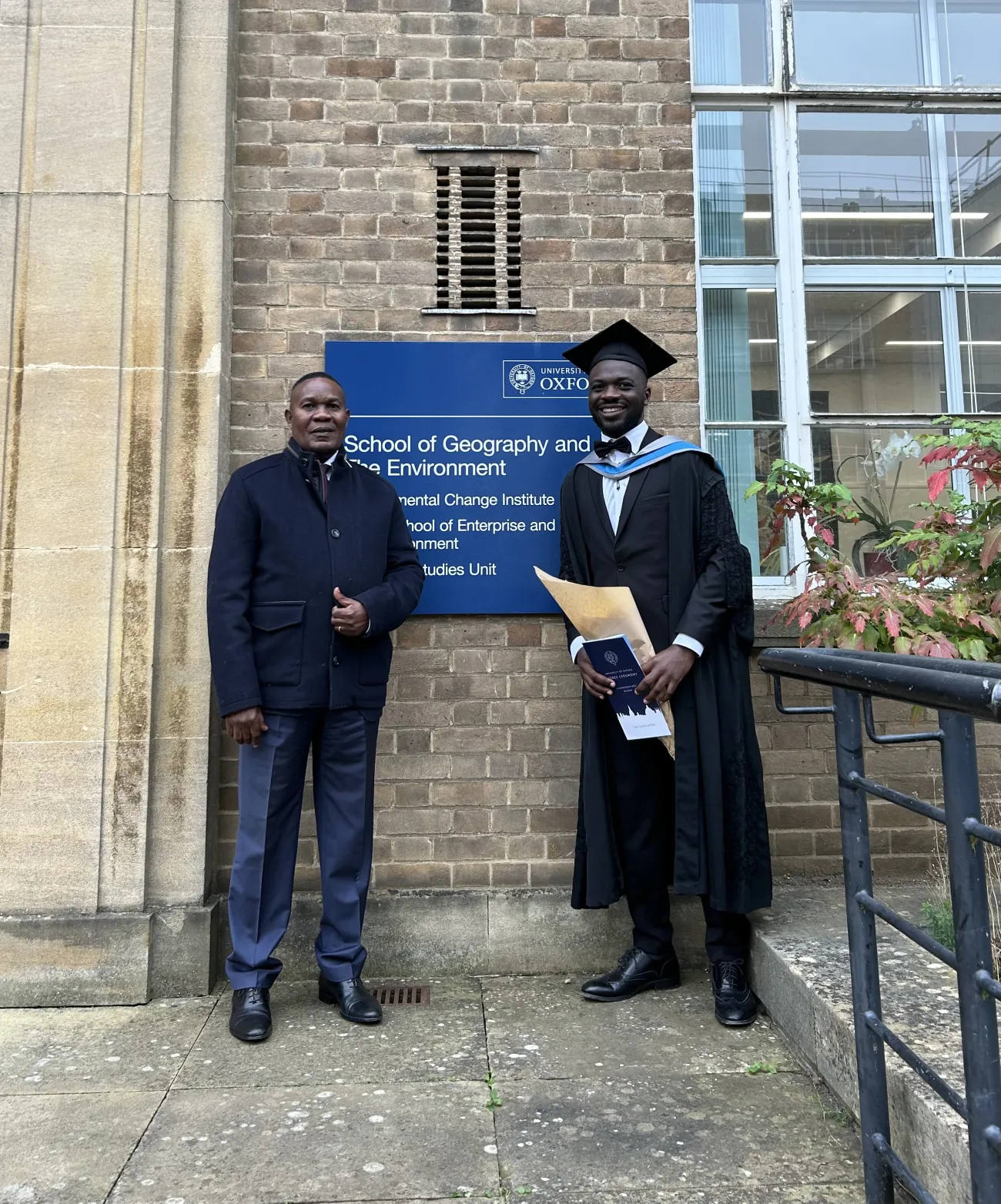
Junior with his father, Prof Mbangala, in front of the School of Geography and the Environment, University of Oxford.
As I begin the second year of my DPhil, receiving the 1st prize for the 2025 Postgraduate Paper Prize from Energy Geographies Research Group of the Royal Geographical Society is deeply meaningful to me. I would like to thank my co-authors, Dr Patrick Mande and my father, Prof. Augustin Mbangala, for their invaluable contribution! This award motivates me to continue my research and encourages me to use it as a vehicle for social development and to make visible challenges that remain often invisible.
I’ve chosen to pursue a DPhil in Sustainable Urban Development (DSUD) because, with my growing interest in energy systems, I wanted to apply the skills I developed during my MSc ECM in a context that specifically examines cities and urban development. The DSUD programme, with its knowledgeable faculty members and interdisciplinary approach grounded in both theory and practice, offers an ideal environment for this. As an occasional geographer and emerging scholar, I aim to use my DPhil to build a career in academia. I aspire to make a social impact by awakening the youth of my generation and inspiring progress and social change.
I'm particularly pleased to have been able to work on the paper “Access to Electricity in Sub-Saharan Africa's Rural Areas: What's the Challenge?”. As an African descendant, profoundly attached to my roots, I have always aspired to build a career that allow me to actively participate in the development of the continent. I had the pleasure and privilege of working with my father, who is also an economist by training. He passed on to me his passion for rigorous and meaningful research, that can be directly applied to people who need it the most. Growing up, I always had a quiet fascination for his work, and today, being able to share that passion and collaborate on topics that matter to both of us brings me immense joy.
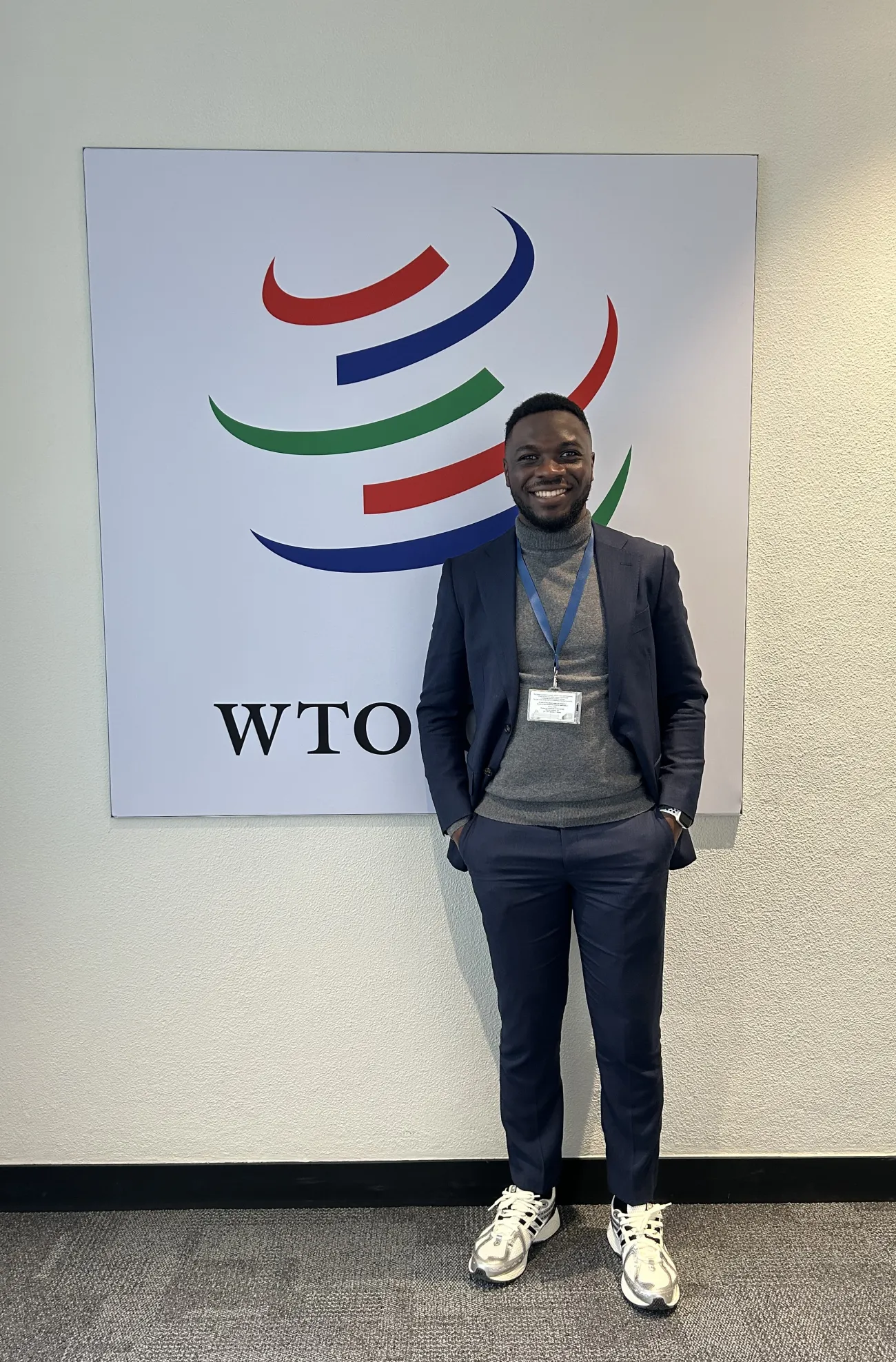
Junior at the World Trade Organization in Geneva, where he contributed to the Trade and Environmental Sustainability Structured Discussions (TESSD).
I recently had the opportunity to apply my knowledge at the World Trade Organization (WTO), where I took part in diplomatic discussions on environmental sustainability, as well as on the best practices in circular economy and renewable energy. This practical experience, combined with my theoretical readings, allows me to envision a future that bridges academic research and its applications in international organisations.
I would like to say to all the students taking part in the ECI master's programme that, by joining it, I was given the chance to come to terms with who I am, to deconstruct certain precepts that once claimed to shape my identity, and to allow myself to be inspired by new realities. I have discovered different ways of interacting, learning, and living. I am not brilliant, but realistic, curious, and pragmatic. I am shaping myself by mastering my fears and through the light of the experiences I have been fortunate to face.
About the author
Junior Mbangala is a former MSc student at the Environmental Change Institute (ECM 2023–2024). He is now a Doctoral Researcher (DPhil) in Urban Development at the University of Oxford (Oct 2024 – present), where he continues to pursue his passion for energy justice and sustainable development.
His winning paper, Access to electricity in sub-Saharan Africa’s rural areas: What’s the challenge? examines the disparity between urban and rural electricity access in the region. On average, 80% of the rural population lacks access to electricity. Junior’s study highlights that renewable energy can improve efficiency in rural electricity production, and that private sector participation could help drive progress. However, the affordability of electricity remains the greatest barrier for rural households. The paper proposes targeted reforms to address these challenges.
Reflecting on the award, Junior said:
When I first joined Oxford, I didn’t know that my master’s would lead me on a research path, and especially to my current DPhil. Looking back now, I’m happy to see how much I’ve grown. Winning this award gives me the fuel to move forward and continue my ongoing work on electricity access. On a macro level, receiving this award allows me to step into a wider sphere of knowledge while also bringing greater visibility to challenges faced in sub-Saharan Africa. As an African descendant, it strengthens my determination to go further, to keep pushing boundaries and opening doors for others.
This recognition wouldn’t have been possible without the dedication of my co-authors, Dr Patrick Mande, and my father Professor Augustin Mbangala. The chance to collaborate academically with my father is an opportunity I will always cherish.’
Junior’s DPhil research focuses on energy systems in Belgium, with particular attention to energy communities and their implications for energy poverty. Alongside his doctoral studies, Junior participates in diplomatic forums at the World Trade Organization in Geneva, contributing to discussions on trade and environmental sustainability.