
A new study from the Environmental Change Institute (ECI) led by Dr Milton Barbosa, Research Fellow, shows that diseases spread by insects in the Brazilian Amazon do not occur randomly, but form clear regional patterns shaped by how land is used and how people live.
The research, published in Communications Earth & Environment, examined more than 1.28 million reported cases of malaria, dengue, Chagas disease and leishmaniasis across Amazonian municipalities between 2015 and 2019.
These diseases are transmitted by insects including mosquitoes, sandflies and triatomine bugs. Instead of appearing evenly across the region, the study found that they tend to cluster into different “disease landscapes” depending on environmental change, rural economies and levels of development.
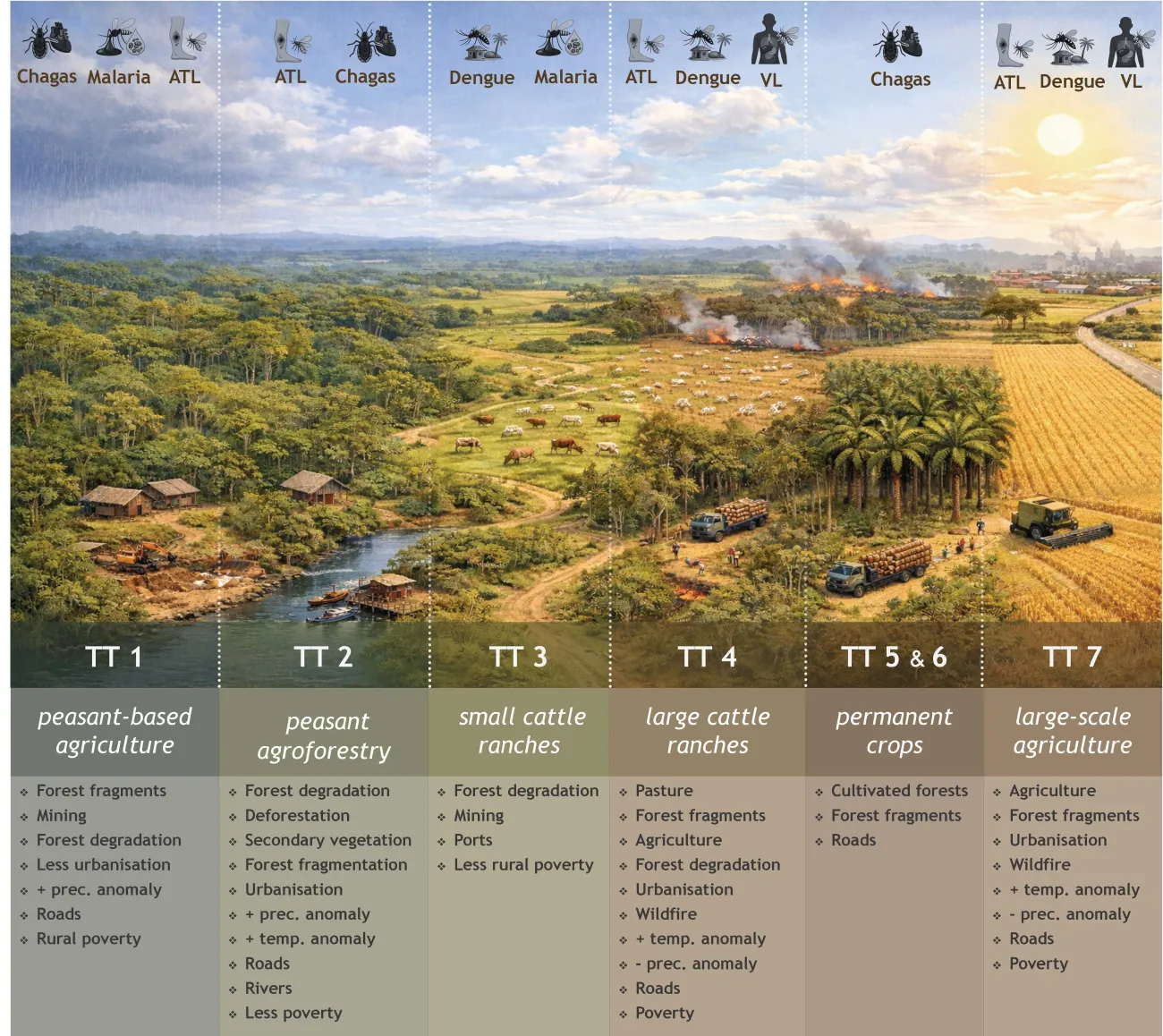
The findings show that where and how people live — including farming systems, forest use and urban growth — helps shape which diseases are most common.
In more forested and remote rural areas, where livelihoods often depend on small-scale farming, forest-based livelihoods and extractivism (the harvesting of natural resources such as rubber, Brazil nuts or timber from forests), malaria and Chagas disease are more likely to occur together. These areas are also often affected by poverty and limited access to health services.
In contrast, areas marked by intensive agriculture, pasture expansion, roads and urban growth, the study found a different disease pattern: dengue often overlaps with cutaneous leishmaniasis. Dengue is commonly associated with towns and cities, while cutaneous leishmaniasis, the most common form of leishmaniasis in the region, can cause long-lasting skin sores and, in some cases, permanent scarring.
Visceral leishmaniasis followed a separate pattern. This more severe form of the disease affects internal organs such as the liver and spleen and can be life-threatening if untreated. In the study, it was more closely linked to urban poverty, environmental disruption such as fires and climate extremes, and economies associated with large-scale cattle ranching and crop production.
Dr Barbosa, Lead author, and Marie Curie Research Fellow at the ECI and Assistant Professor, Federal University of Minas Gerais (UFMG), Brazil, said the results show that disease risk in the Amazon is closely tied to environmental and social change.
Our study shows that diseases do not follow only the biology of insects that transmit them. They also follow the way land is used and how societies develop over time. This means that different forms of development and land occupation create different disease landscapes across the Amazon.”
The study uses an approach that looks at multiple diseases together to identify shared underlying drivers, rather than studying each disease separately.
Co-author Professor Claudia Codeço said the Amazon should be understood as a mosaic of very different environments rather than a single uniform region.
There are many Amazons, each shaped by different patterns of land use, movement and environmental change. These differences influence which diseases appear where.”
The authors say the findings could help public health systems better target prevention and surveillance by focusing on areas where multiple diseases share the same underlying causes.
They also highlight that protecting forests, improving living conditions and managing land use more carefully could have direct benefits for public health as well as the environment.
Read the full paper in Communications Earth & Environment: Vector-borne disease co-occurrence is shaped by agrarian economy and socioenvironmental contexts in the Brazilian Amazon